**This is a guest post by Matthew Apsokardu. A student of Okinawa kenpo Karate and Kobudo for over 13 years, Matthew has become best well known for his writings at Ikigai | Blogging the Martial Way**
The dojo is a wonderful place isn’t it? Bright lights, open space, flat floors…nice and predictable. In fact, it serves as a perfect petri dish for learning techniques. Unfortunately we aren’t always so lucky to find ourselves in such ideal circumstances.
Terrain and environment is a big issue that sometimes gets overlooked during martial arts training. Although it might not seem like a big deal at first (a good technique is a good technique, right?) different environments can change up a successful self defense game in an instant.
Is it wise to go to the ground if there is broken glass there? Is it wise to grapple if someone has a knife? Would you want to punch someone in the chest if they are wearing a thick winter coat?
These kinds of contingencies can never be predicted, but practitioners of the arts can create a mindfulness of there existence.
Making the Mental Adjustment
The first key to planning for environment is to make the mental leap that the unknown exists. No matter how good your technique, when faced with a self defense problem, it is unlikely things will work out as cleanly as you want them to.
Accept that it won’t be pretty. Understand that getting out alive and hopefully less worse for the wear is the ultimate goal, even if things didn’t go smoothly.
Training Tips for Training
My biggest piece of advice for increasing your awareness is to take the time to step out of the box. 
First, step out literally. Make the effort to train outside your dojo, whether it’s at home, in a parking lot, or in the backyard. Wear street clothes that you normally wear on a day to day basis.
By doing this, you’ll be able to get a feel for how your non-gi clothing reacts. Furthermore, you’ll be able to identify bad habits you may have in shoe, clothing, and accessory choice.
Second, step outside the box conceptually. Turn the lights out in the dojo and train in the dark (unless it gets pitch black, then use a little bit of light). Use multiple opponents, sometimes with weapons, sometimes without.
Most of all, put yourself into situations where you think ‘ohh crap!’, and feel very uncertain. This is important because you can confront those feelings of uncertainty in the safety of the dojo environment. If you wait to feel panic and stress until an actual confrontation, you can’t be sure if you’ll know how to manage it.
**A personal thanks from me to Matt for writing my first-ever guest post! …It’s quite exciting really :-) It’s a great post with an important message – a link to Matt’s site, Ikigai | Blogging the Martial Way, is also available in my Links column on the right. Please feel free to comment with ideas and anecdotes from your own experience in training to plan for various environments.**
The Arm Drag is a ridiculously simple move, so simple that I don't even like thinking of it as a technique in itself! To perform it, you just need to grab, pull and guide your opponent's leading/attacking arm (yes, with more finesse than I've described it). It works on the age-old martial arts concept of using your opponent's size, weight and momentum against them. That is, when your opponent's momentum is advancing forward (or alternatively, his posture is such that his size and weight are pushing his body forward), you grab and guide him in the direction he was already moving (often pulling him off-balance). Depending on the scenario, the move can be performed with explosive force or with gentle, well-timed grace. Here's Marcello Garcia showing you how it works:
Long & Short
Personally, I like the break the arm drag down into two categories: The Long Drag, and the Short Drag. A long drag involves you gripping your opponent's wrist/forearm and guiding him a longer distance (think: Aikido) – this movement becomes especially useful in conjunction with wrist locks, sweeps and heavy striking techniques (more so from when you are standing). The Short Drag involves you gripping your opponent behind the elbow, usually resulting in less overall movement – the resulting scenario is usually ideal for shoulder barges, major hip throws and taking your opponent's back (though an elbow to the back of the head never goes amiss either!).
If timed correctly, a Long Drag can be used to lead into a Short Drag. Both are suitable for gi/no-gi applications.
Application
Arm drags are especially useful against aggressive or dirty fighters who opt to shove, tackle or grind their arms into you (usually their forearm across your face). In fact, the reason I first used an arm drag in BJJ is that someone in my guard was grinding his forearm over the bridge of my nose while punching at my ribs; I pushed his elbow across, (short) dragged his arm and took his back – love connection made.
Furthermore, arm drags are especially well-suited for smaller fighters (finally, gravity is on our side!) as their opponents often need to lean further forward (or in my case, almost crouch!) in order to efficiently attack. There's a psychological aspect that helps here too – I find that most fighters (even guys who'd otherwise opt for a more defensive/reactive style of playing) when facing a smaller opponent immediately want to dominate by rushing forward or dropping their weight on them.
As I've mentioned, the arm drag is ridiculously simple – so simple, that people get it wrong all the time! It literally is guiding your opponent in the direction he's already poised to go.
-
Don't make the mistake of tugging and pulling in a direction your opponent clearly isn't moving – to move him will take a lot of strength and it will tire you out in the process.
-
Remember to move your body appropriately (it's all in the hips) when attempting a long drag otherwise you may find that you've just given your opponent a better position – I think of it like this: I'm dragging my opponent a longer distance, so instead of counting on him to make the journey all by himself (your opponents aren't the most trustworthy people after all), I'll help him along – either by scooting to the side or step around myself (tai sabaki).
The Ki/Chi debate is all over online messages boards. Personally, I've never bothered to comment on any but I do very much enjoy reading the arguments from both parties (believers and non-believers). The debates do tend to get unnecessarily heated and often end up with plenty of personal insults and online forum warrior-style challenges. Which is a shame because I think it is a really interesting topic!
What is it?
Ki is explained to be a 'natural energy' or 'energy flow' which (depending on your source) either fuels life forms or is an element of life force or is a naturally present element. It is explained to be a different concept to the Chinese chi (or qi), which is allegedly less well-defined than its Japanese counterpart. Though essentially, the terms are somewhat synonymous – they're both just referring to 'natural energy-ish stuff that we can't quite explain'… the Nei Ching (credited as one of the first Chinese references to ki) describes it as a 'universal energy that nourishes and sustains all life'. Its application is most often used for healing practices (think Reiki), but it is best known internationally for its martial arts claimants. I'll be using the term ki since I'm more used to saying it (background in Japanese martial arts etc) but I'm referring to both concepts (which are really just one concept).
An alternative explanation stems from Hindu beliefs regarding chakras, which are believed to be the nexus of metaphysical and biophysical energy residing in the body. I remember reading (but not the source…sorry, it was a long time back!) that ki is said to be derived from myths/superstitions regarding the second primary chakra known as Swadhisthana (meaning "One's own abode"). The idea is that the Swadisthana is where many untapped, 'potential karmas' (samskaras) lie dormant. 
Adding to that, the second chakra is also said to home Kriya shakti (literally "strength of actions/deed/effort"), which in yogic (as in Yoga) traditions is considered to be outward manifestations of the power of thought. I further remember coming across articles that Prana (Sanskrit for 'breath'), in Vedantic philosophy, can be harnessed and physically manifested – something which was associated with the Kundalini form of yoga.
Note: For those of you that are well-versed in Hinduism, Sanskrit traditions, or yoga, please do let me know if I'm off on the details – it's been years since I read about any of the topics and since I'm in the office at the moment (yes, I write my posts when I'm not being productive) I'm writing on memory alone (…and I get hit in the head a lot)! Hmm…maybe I'll get out my copy on the Upanishads when I get home…
Popular Culture
 Probably best known in its 'energy blast' form, ki in popular culture is seen as a mystical, magical form of energy drawn out of nature for use in healing and attacking. The Street Fighter series refer to it as 'Hadou', and its most famous depiction is probably Ken and Ryu's hadouken (…shame on you if you don't know what I'm talking about). The idea generally plays a big role in most fighting games and many manga, anime and movies – Fatal Fury, Naruto (which refers to it as chakra), Hero Tales etc.
I think it's this representation of ki that upsets people most. Not so much when it is used in games, anime or movies but rather when they see the equivalents in martial arts practices as in the following section.
Martial Arts – The Mystical Version
"With concentration, karatekas can move their ki up and down, so their source of energy is higher and lower. Experienced karatekas generally center their ki, in order to achieve maximum balance and power. Ki is absolutely crucial in the higher levels of karate: It gives masters the power they need to break blocks and topple much larger opponents."
- Tom Harris http://people.howstuffworks.com/karate6.htm
The mystical explanation describes ki, our energy flow, as a source of power for the martial artist. It is intangible and of some supernatural origins – it is stored in the hara (Japanese) or dantien (Chinese), about an inch or two below your navel, and can be channeled into the different parts of your body enabling you to perform feats previously not possible. Masters of ki are further able to control the energy so far as to project it from their bodies in a sort of energy wave (but lacking the flashy, attention-seeking appearance of the hadouken).
Other seemingly far-fetched claims involve using ki to manipulate objects and stop babies from falling down staircases in a fashion similar to telekinesis. As seen in the above video, attempts to prove ki blasts etc. tend to fail against people from outside of the performing dojo (at least all the ones I've seen) – various explanations have been provided for these repeated failures though none have satisfied the critics.
The Shaolin Monks are famous for performing 'iron body' techniques which demonstrate their ability to harness and channel ki through Qi-Gong training. A popular ki-demonstration used by street magician-esque martial artists (think Chris Crudelli) is that of the 'Unbendable Arm', which is in reality a feat that has less to do with esoteric energies and more to do  with maintaining a superior biomechanical position (with some positive thinking for good measure) . As such many of these alleged ki demonstrations (even though they occasionally require a lot of skill) lack the ability to convince many on the existence of ki.
"There is nothing so strong as gentleness, and nothing is so gentle as real strength."
- Ralph W. Sockman
The Science Behind Ki
Ki is alleged to travel through the body's 12 'constant' Meridians (as well as some others but less directly). Ki flow must be in a single direction – Ascending or Descending (sometimes described as Positive and Negative) depending on whether the respective Meridian is dominated by Yin or Yang. Furthermore, the flow can be stimulated, blocked, and unblocked through concentration and physical intervention (such as pressure point attacks).
A few scientific tests have been conducted in order to test for the presence of ki but as of yet, nothing has provided any viable positive results. Various theories have propped up suggesting that ki is a way to refer to our body's natural capacity to produce electricity and plasma in which case, the healing properties of ki can sort of be accounted for…but not so much in regards to its martial application (or the ki blast).
Martial Arts – The Logical Version
It's plausible that ki doesn't really refer to ki or any mystical elements at all. Many suspicions lie in the direction that ki is really more of a metaphor than anything else. Given that in the past, the vast majority of martial arts students were uneducated and of a rural background, masters would've needed a means to better illustrate various concepts (biomechanical as well as psychological) via a comfortable metaphor that the students could easily envision. This is supported by the fact that in the Japanese language, -ki is often used without any magical or mystical connotations (for example: genki means "good health") – so there is some possibility that the concept is something that was simply lost in translation once it arrived in the West (well, except in the case of ki-blasters).
In this respect, I suppose the purpose behind ki as a conceptual metaphor in martial arts would be threefold:
-
1) Open, connect and relax the body; regulate and control breathing patterns;
-
2) Focus, develop and strengthen notions of 'intent' whilst performing techniques;
-
3) To create an understanding of the synergy between points 1) and 2).
Furthermore, the idea of ki could be (and is) very easily used as a motivator. For students who suffer from insecurities and self-doubt, the belief that they are able to draw from a greater source of power could indeed provide them with the confidence and motivation needed to excel in their art.
And then there is 'Kiai-jutsu' – that is, using the kiai (which can be understood as, but does not literally translate to, 'spirit yell') as a weapon. The kiai is essentially a loud shout used in Karate (and many other arts) in order to startle an opponent – Kawazoe's kiai is a good example of this! – as well as to teach beginning students to exhale when attacking. Of course to some, the kiai is more than just a loud shout, as denoted by the kanji it is comprised of (ki + 'ai' which is 'harmony' or 'love'), the kiai is interpreted as the projection of sound harmoniously fused with energy or spirit (hence, 'spirit yell').
Morihei Ueshiba (founder of Aikido; Note: Aiki is comprised of the kanji for Kiai written backwards) can be seen in various demonstration videos exerting the power of his kiai in which he intimidates/startles attackers to the extent of toppling them backwards. Though it should be noted, these 'attackers' are his students who probably reside a healthy fear of their teacher.
A more far-fetched example is the 17th Century story of Matajuro Yagyu, who was practically disowned for lacking talent as a swordsman (he was from the Yagyu clan, famous for its swordsmanship) and also due to some misconduct. After training with various masters, Matajuro returns to plead acceptance (but through an intermediary as his father refused to see him!); he is unable to show his skill due to the lack of an opponent. Instead he fixes his intent on some sparrows in a distant tree, he utters a loud kiai and the sparrows fall to the ground motionless. Shortly after, the sparrows regain consciousness and fly away. Matajuro went on to inherit his father's system. Note: Japanese sword schools often referred to this as 'toate no jutsu', the 'art of striking at a distance'.
A better known anecdote featuring Matajuro is his encounter with Zen sword master Tsukahara Bokuden. Matajuro asked the master, "How long will it take me to master the sword?" to which the old man replied, "About five years if you train very hard."
"And if I trained twice as hard? Then how long would it take?"
"Oh – in that case, it'll take 10 years."
Plausible Deniability Section (because I'm an optimist…ish)
As far as my experiences go – which I admit are very limited given that I've never really gone searching for ki-based arts and that I've never really devoted any amount of training to any system that is ki-based – I've not witnessed anything that would really fit the conditions of mystical, supernatural ki (did I mention that I've heard 'ki-enhanced music'? Live performance - True story) – and really, what we call 'supernatural', is really just something we haven't yet broken down in specific scientific terms.
Given that the idea behind 'ki as a metaphor' is to simplify things, it's actually pretty complicated – the synergistic kinetic energies created by our bodies when engaged in activity with appropriately conditioned intent/focus whilst maintaining a relaxation on the muscular state; ability further enhanced by the efficient regulation of respiratory patterns – something like that, right? …If I had been a master at the time, I think I would've just picked up a cane and said, "Concentrate or I'll give you a baboon's ass… okay, good – now relax your bodies".
That's not to say I have a definite belief that ki doesn't exist. I sincerely acknowledge the possibility of ki as a yet not properly understood energy/element that is processed either in nature or the human physiology itself that can be channeled through the muscles to enhance our own physiological functions (quite possibly in a similar way to oxygen). Just because we have not discovered something yet via a scientifically empirical study doesn't necessarily preclude its existence. Perhaps our understanding of ki is similar to our previous misunderstanding that the world is flat – in this case, ki would be akin to the theory of gravity.
"Human salvation lies in the hands of the creatively maladjusted."
- Martin Luthor King Jr.
I guess that makes me somewhat agnostic regarding ki. Either way, it's not something to fuss over – whether you're a diehard ki zealot or a diehard ki atheist, let those who believe, believe. And leave them be who would rather not open themselves up to the possibility. Calling for challenge matches and being a nasty web warrior (or on the other hand, a pretentiously enlightened web 'master') is just a bit lame. Don't waste your time, go train instead!
One of the earliest posts I wrote on this blog was The Triangle Hypothesis, which talked about three facets key to improving as a martial artist or fighter. For those of you who've read it, you may remember that I chose to add 'C' to the 'triangle' that many past instructors of mine had related to me. The C in this case stood for Cardio & Conditioning. The logic behind my decision was that without the right levels of fitness and body conditioning, you would be unable to fully utilise the three corners of the triangle that are Power, Speed, and Technique. This post intends to elaborate that view.
It's not by sheer randomness either - While rolling last night (my first night back! *sigh*), I was caught in a surprise Achilles ankle lock (and took a nasty elbow to the brow) and as a result, walking just doesn't feel right anymore – but instead of depressing you (my ever-emphatic reader) with a post about how my leg hurts or about how my eye looks like I was the loser of the Thriller in Manila; I'm going to write about my clever improvement of my instructors' theory with C (even though I'm pretty sure most of them just assume that C is a given).
"Minds, like bodies, will fall into a pimpled, ill-conditioned state from mere excess of comfort."
- Charles Dickens
It's no secret that the more time you spend on the mats (whether rolling, stand-up sparring or drilling), the faster you will improve. And we always hear how martial arts (especially those considered 'Traditional' styles) are all about Technique being used to overcome Athleticism, so then why have I devoted an entire post to Cardio/Conditioning? The answer in short, is that unless you have vastly superior technique to everyone else – your endurance and conditioning is going to play a factor. 
If you're looking to excel in competition (you old glory hound, you), stamina is clearly needed as you'll have to spar several rounds with relatively little rest in-between. Furthermore, if you like competing in the Absolute division (or equivalent weight-free zone), it's possible that you'll be sparring against bigger, stronger opponents who will sap the stamina out of you! There's little you can do when you're completely drained of energy against a well-trained bigger, stronger opponent so the best option is to train hard before the competition to ensure it doesn't happen.
"The time to repair the roof is when the sun is shining."
- John F. Kennedy
Non-competitive types need to be wary of the same points. You may not be competing at tournaments but note that the competition format is pretty similar to sparring sessions in training. If you don't have a high level of stamina, you won't be able to train as efficiently – i.e. Half of your 2 hour training session is wasted if you only manage to train hard for 1 hour before gassing. Though some of you may here point out that training isn't about all about 'quantity' but rather 'quality'…and you're right. However, once you begin to fatigue, your technique without a doubt begins to slowly deteriorate and while training at this point is arguably still beneficial (any training is better than none in my opinion), it is less efficient (the exception here is when you intentionally fatigue your body so as to limit your use of strength and to focus on working techniques).
And as an old boxing coach used to tell me: physical fitness improves 'mental toughness'. But is that enough? Sadly, no – as martial artists, our training all too often focuses on 'dishing out' while we spend relatively little time conditioning ourselves for the more unpleasant reverse scenario of being the 'main dish' (also quoting my old boxing coach).
In fact, I'll just explain it to you the way the old man would rant about it to me (minus some explicit wisdom)! It helps to know that Coach A was appalled by modern boxing tactics where boxers 'dance around' and 'play for points', he was a staunch believer that you punch for the knockout ("There's no such thing as a jab" he'd say).
Exercises to toughen the body have been all but forgotten. Competition has led to extensive cardio training so that fighters can last entire fights (most of which are spent running in every direction except towards your opponent). Exercises to toughen the body to withstand the rigours and demands of training and combat have been more or less discarded. Coach A used the example that most boxers have never boxed without heavy gloves and thorough wrapping – how's one expect to condition their  hands if they're wrapped up and then further protected by a fat padded glove? Jack Dempsey makes a point of it in his book Championship Fighting: Explosive Punching and Aggressive Defense, urging the rookie boxer to train with ‘striking gloves’ or by “snipping the fingers of a pair of leather work gloves” so that he can condition his fists.
Martial arts such as Karate require even more conditioning to deal with tackles and attacks below the waist. Furthermore, developing the ability to withstand the constant (but minor) injuries sustained in training is paramount as it to an extent, dictates the level of confidence you have in the said art – so hit that makiwara until it apologises to you!
The Best Way to Cardio and Conditioning
This is one of those obvious points that's so obvious people don't notice it. The best way to develop the required stamina and conditioning for your martial art is simply to train…a lot! Not only does that ensure that you'll be developing your body in a natural way that complements your art but, you'll be doing it via means that you already love doing (the assumption here is that you enjoy training)! Make sure to train hard and push yourself in all aspects of your art, otherwise you may find your body woefully underprepared later… and please make sure to properly warm-up, stretch, and cool-down. Here's a clip of Goju Ryu 10th dan Morio Higaonna – he uses a rock to condition his fists… He's a scary man (though apparently a really nice guy too!).
The next best thing…
If you're gym/dojo/basement happens to be closed, you're a little shy about training in the park, and no one is around to play sports with, there are plenty of other options. Main thing – find something challenging that you enjoy. Personally, I hate elliptical and body building machines so I steer clear of them. Instead I prefer to swim (with the occasional bit of underwater karate when the coast is clear!) or go for runs at varying speeds (undisciplined interval training). One of my training partners hates exercise and formal workouts; he instead chooses to dance on days off from the dojo – I've joined him a couple of times… two hours of salsa/hip hop is surprisingly hard work!
Dieting
Though I know plenty of people that are constantly dieting in order to make weight, I'm not really a fan of the process. Personally, I think it’s better in the long run to follow some healthy eating habits and maintain a weight that is natural to your body even if it means that you end up at the bottom of your weight category – after all, why would anyone really want to fight someone much smaller than them (unless the ickle opponent is an absolute badass)?
Recovery Time
Whatever means of cardio and conditioning you choose, make sure to get in ample recovery time. Not only will this help your absorb information/techniques faster but it will allow you to perform at a higher rate with a lower risk of injury. And yes, sometimes you'll just need a week or two out from training – don't worry about losing the short term training as taking time off not only helps you recuperate but, it also allows your body to fully assimilate the training you have done recently (just be sensible about how often you take time off).
*Sigh!*
You may have noticed that I've used more boxing references than I usually do in this post. It's because my head is still going over Amir Khan's defeat of Marco Antonio Barrera from last week. The "Baby-faced Assassin" (Barrera) is one of my favourite boxers and it's sad to see him dominated (though I suppose I must admit, he has been on the decline for some time now). Ah well…c'est la vie!
Also referred to in BJJ as the "Mata Leao" 
The RNC is a peculiarly named but highly effective submission. To understand its somewhat dubious-sounding title, we have to go back to its usage in classical ju-jitsu and/or judo where the technique was referred to as hadaka jime, which literally means "naked strangle". In this context, 'naked' is referring to the fact that unlike many other strangles this variant does not require the use of a gi (those white pyjamas we wear!). This leads on to the second peculiarity in its name, the rear naked choke is not a choke at all, it is a strangle. The difference is that a choke cuts of the oxygen supply to the lungs whereas, a strangle cuts off the supply of blood to the brain.
By blocking the carotid arteries, this technique can render a person unconscious in less than eight seconds; prolonging the hold can lead to brain damage and death – in 2005, Rafiel Torre, a former MMA trainer and competitor, was convicted of murder after using the RNC to kill his lover's husband.
The RNC is used in a variety of martial arts classes and resulting injury is a rare occurrence. It should be mentioned however, that if applied improperly (occasionally, the military style 'V-grip'), can lead to a crushing of the trachea as well as causing the submission to act as an airway choke. Here’s Bas Rutten explaining the basics:
Once you've got it tightly locked in, the RNC is a fight finisher. However, taking someone's back can be quite a challenge – especially against grapplers who are well aware of the impending strangulation! Furthermore, once you obtain the Rear Mount, locking in the submission requires a strategy of its own (especially against stronger opponents who firmly grab hold of your arms) – this is where the following video by Stephan Kesting of Grapplearts.com is a godsend:
It's an interesting fact that Karate is widely believed to be an art comprised solely of static punches, kicks and blocks. It seems that no matter how many times I explain the difference between the basics forms, their functions, and their applications in Karate, people find it terribly difficult to comprehend Karate as anything other than prearranged punches, kicks and blocks (with a few shouts thrown in for good measure – an instructor of mine once told me, "When in doubt, 'kiai'!").
Karate has grappling? Sez who?!
"One must not lose sight of the fact that karate is "all-in" fighting. Everything is allowed: Every effective method in no matter what form of combat sport exists in Karate, redirected under the dramatic conditions of a man's desperate fight for life, using the means given to him by nature. This is why karate is based on blows delivered with the hand, the foot, the head or the knee. Equally permissible are strangulations, throwing techniques and locks”.
- HD Plee
Once you study and analyse kata (as opposed to just mimicking them), you realise that many block-strike techniques in the kata make little sense when applied to realistic scenarios. There's a good reason for this – it's because these techniques/combinations were never intended to be applied as block-strike patterns, rather these are often aesthetically formalised grappling techniques.
“There are also throwing techniques in karate… Throwing techniques were practised in my day, and I recommend that you reconsider them.”
- Shigeru Egami
The founder of Shotokan Karate, Gichin Funokoshi asserts a similar view in  his book Karate-Do Kyohan stating that "….in Karate, hitting, thrusting and kicking, are not the only methods, throwing techniques and pressure against joints are included"…and why wouldn't there be? After all, karate is a civilian fighting system devised by the Okinawan population, formulated for the sake of defending one's self and others. As such, it's only natural to have close range and grappling techniques – without them, the art would be severely one-dimensional.
There's even a word for it – Tegumi, literally meaning "hand grapple", is used to refer to the grappling aspects of karate; it is likely to have been based on the indigenous wrestling style of Okinawa which in conjunction with Chinese martial arts were to form the basis of Okinawan Karate (the 'te' in 'karate' is likely to represent 'tegumi'). Karate tegumi emphasises close combat principles of grappling and striking coupled as a single (range-dependent) aspect of fighting.
Where'd it go? Why don't I see it?
Well, the simple answer to this is – It didn't go anywhere. You don't see it because you've not looked for it and/or because you've not been shown it. Prior to the early 1900s, the striking and grappling aspects of karate were equally stressed in training – that is, in addition to striking techniques, regular karate training would include throws, chokes, joint-locks, sweeps, and strangulations via the application of kata.
“Kumite is an actual fight using many basic styles of kata to grapple with the opponent.”
- Choki Motobu
In the early 1900s, Karate underwent a series of changes in order for it to become an acceptably safe addition to Okinawan schools' physical education programmes – as a result, the art was unconsciously 'diluted' with many of the tegumi aspects removed so as to be able to easily/safely teach the art to young children (older students that were deemed 'worthy' were later taught the applications of kata). This left training incomplete for many practitioners.
Furthermore, when karate was introduced in Japan – as per standard Japanese customs, it was sought to be regularised through the introduction of a uniform, grading regimen, standardised competition (albeit this was slightly later) and… the exclusion of excessively violent techniques (as a result, bunkai training became even more secretive than it already was) as they were considered distasteful and detrimental to society. It was also around this point that the kanji used to write 'Karate' was switched so that the meaning changed from 'China-hand' to 'Empty-hand'.
Popular bunkaiologist (Word of the Day…go write it down…okay, I lie – it's not a real word), Iain Abernathy, states that without "thorough understanding of kata we are left with only a fraction of the karate syllabus. The commonly used techniques (kicks & punches) take up around 5% of the information available." I shouldn't need to explain that missing 95% of a martial art system is well, not necessarily a good thing (though personally, I'd say 95% is a bit of an exaggeration; his article is available here)!
Abernathy furthers points out that though practicing the applications of kata, and utilising these applications in sparring has become more popular in recent years, many so-called 'applications' remain impractical and impossible to use against a non-compliant opponent. Of course, given the history – there isn't any definitive means to determine the exact intended applications of the various kata.
Grappling & Ground fighting
 Let's be clear what I mean by grappling/ground fighting techniques – you're not going to find many of the tremendously sophisticated ground fighting techniques that you will find in ground and grapple-oriented fighting arts; the karate system was not designed for prolonged one-on-one matches against skilled grapplers.
I know a few people – let's call them kata apologists – who look for the weirdest, most wonderful ways to suggest that kata has every single technique imaginable. Really, that just doesn't make much sense (can you imagine Funokoshi grabbing Shigeru during a training session, pulling him into rubber guard and working for a locoplata? …It sounds awesome but also unlikely!). The main purpose of karate ground techniques is to incapacitate (or distance) your opponent as quickly as possible so that you can stand up to address any other incoming threats. As such, techniques attacking the groin, throat, eyes and hair are all acceptable.
What karate does have in way of a grappling system is a myriad of  takedowns and throws (the vast majority of which are designed to work best in conjunction with strikes), a massive variety of grapples/joint locks from a standing position, and some basic ground fighting techniques which are designed to minimise the duration of the fight on the ground. Furthermore, there are some basic takedown defences – most of which focus on common brutish attacks such as tackles, bear hugs and shoves.
It's the principle of the matter…
 More important however than the actual grappling techniques that are present in kata are the principles of combat that are available. While the applications of specific techniques are limited, the utilisation of the principles of behind these techniques allows for a far greater scope – furthermore, they allow one to be a flexible fighter, adapting knowledge and techniques on a conditional basis.
"One must withdraw from the kata to produce forms with no limits or else it becomes useless."
- Hironori Otsuka
Sound familiar? Let me present it to you in a better known phrase:
"From form to formless and from finite to infinite."
- Bruce Lee
Now, Bruce Lee was not a kata advocate at all stating that pre-arranged sequences to battle off choreographed opponents is silly (and rightly so! As I've already hinted at, kata are not choreographed sequences to battle multitude of very understanding attackers but rather a convenient means of storing and teaching a collection of techniques and principles). However, when it comes to the actual traditional principles stored in kata, we can see that Lee's thoughts mirror those of traditional masters. Grasping the principles of kata allows a karate-ka to adapt his/her techniques; it allows you to bend with the winds of adversity by adapting the principles in a finite series of sequences to create infinite possibilities – truly, from form to formless.
Karate for the Next Generation
Alas, it's a new millennium, and while the basic dynamics of a fight probably haven't changed all that much, other significant changes have taken place. For a start, due to wider access to gyms, bodybuilding information, and nutrition, attackers are likely to be bigger and stronger than they once were – let's not forget the popularity of elements such as steroids, amphetamines, and alcohol adding a wistful aspect to many an attacker's capabilities.
In his article, Throws and Locks in Karate Kata, available here, Harry Cook (Goju Ryu 7th dan, and Chief Instructor of the Seijinkai Karate-Do Association) recounts how one of his dan-grade students – a policeman – was unable to subdue a large, intoxicated aggressor using just forceful punches and kicks (including some to the groin). The policeman, known as 'C' (mystery for the sake of anonymity), eventually settled the incident by applying strangle hold. This is a pretty clear example that the grappling aspects of karate are still in use and indeed, useful! (In the same article, Harry also tells us that the dinosaur, Struthiomimus, had very similar skeletal features to that of a modern ostrich as an example of how nature, form and function are related)
Moving on, thanks to Jackie Chan and The Matrix movies (and also the MMA generation to no small extent!) martial arts have boomed, it's pretty easy to find martial arts training regardless where you live; as such, it's a good idea to moonlight at martial arts schools other than your own to experience the vastness of approaches available in self defence (and fighting in general).
Moreover, if you follow the logic that 'thugs' are attracted, much like moths to a flame, to the violent nature of combat – it is natural to assume that  many may have had some limited training in easily accessible 'hard' style arts such as Boxing, Karate, or nowadays, MMA (I still don't agree that MMA should be considered a style in itself but there are plenty of schools that teach the 'pressure-tested art of mixed martial arts'). Besides, if Charlie the Chimp can pick up a nidan, then a your local hoodlum should just about manage a 4th kyu!
Granted, given that delinquency is closely related to a lack of personal discipline, it's safe to assume that said 'thug' has not trained extensively in any style (though some are remarkably disciplined! I remember a vicious amateur boxer named 'Tyrone'…), it's important that we as the current generation of martial artists take this possibility into account with our training. I'm not suggesting that everyone join Muay Thai and BJJ classes or devote 3 hours a week to applications against trained fighters but rather, we should develop a familiarity with the grappling aspects of our own styles (yes, most traditional styles have them – karate was not exclusive in this respect). After all, it just makes sense to have some understanding of the techniques that attackers are likely to use against you (i.e. a paper shield has limited use against a water gun)!
You don't even have to spend years deciphering kata (that is, in the case that your instructor doesn't teach you bunkai and oyo), you'll find similar techniques in many other arts – take advantage of the fact that we can learn from more than one school of thought!
We must always look to adapt and evolve our systems to benefit us on an individual level – however, don't nuke the city because it could use a few new bridges! Actually, let me clarify on that before I end – like a city, we first need to build a solid infrastructure or foundation in our chosen art. It's only once we have a solid base that we can begin to cut away, restructure and sculpt our methods for them to be truly beneficial to us (otherwise you end up a confused and tangled mess, lacking the ability and experience to perform any of that which you’ve been taught).
“Karate may be said to be a hard technique when compared to the soft technique of ju-jutsu, but softness includes hardness and hardness includes softness. In other words softness is necessary to become hard, and hardness is necessary to become soft, and to begin with both softness and hardness are one.”
- Gichin Funokoshi
I’ve had a pretty lame week. Not only have I been unwell, unable to train, and stuck in the office for 16 hour shifts (no kidding!)…I’ve also been craving a particular type of cupcake, which I just can’t seem to find! However, this made it all better for me.
On March 8th, Shinya Aoki and David Gardner duked it out in Saitama (Japan) for the opening round of the Dream 7 Featherweight Grand Prix. Aoki (“The Baka Survivor”) has already made a huge name for himself, and Gardner (forevermore known as "Hello Japan") isn’t completely unknown either.
The Dream 7 event failed to pull in high viewer ratings, but the fight finisher between Aoki and Gardner will be on highlight reels for years to come.
Wow…
Look at it this way, at least Gardner got to say hello before the fight ended (I love the fact that the commentator says “Goodbye Japan!” during the tap out)!
There are a myriad of martial arts documentary shows available to watch on television – some of them are great references for information, others less so (but still massively entertaining). References from these shows are thrown around the dojo quite often so I thought I'd post an article about what I believe to be the Top 5.
I'll just clarify that this post is only referring to martial arts series that have hit the mainstream; and I'm not looking at stand-alone documentaries (for example, Myths & Logic of Shaolin Kung Fu). And of course, this list is completely subjective so I'll attempt to briefly explain why I choose the shows I do. Feel free to disagree!
5. Fight Science
Initially planned as a stand-alone documentary, the show spawned three direct spin-offs titled, MMA, Special Ops: Super Soldiers, and Self Defence; as well as a dreadful ‘documentary’ based on the initial premise, dramatically entitled Kung Fu Killers: Top 10 Kung Fu Weapons.
Pros: The Fight Science series has been a mega hit with audiences. It has generated a huge awareness for martial arts and the capabilities of martial artists. It also attempts to tackle 'Martial Arts Myths' and the 'Which style is best?' question using scientific tests making it fairly unique – it was also the first show to use motion capture technology to explain techniques.
Cons: The biggest names on the show (Rickson Gracie, Dan Inosanto) were woefully underutilised. The scientists unfortunately have just about no knowledge regarding the martial arts (and also lack some common sense) in that they expect to be able to make a linear comparison between almost randomly selected practitioners! For example, comparing the punching power of an ex-pro heavyweight boxer with that of a lightweight kung fu forms champion is just silly! The follow-up episodes rectified this to an extent by testing the abilities of the individuals (and it's always amusing to see Bas Rutten flirting with some scientist in awe) though the tests/conclusions remained heavily flawed and unempirical. Actually…I could go on for pages on how poorly the tests were conducted – either way, it's an entertaining show with some interesting results…just watch it realising that the scientists don't really know what they're testing!
4. Human Weapon
 Aired on the History Channel, this was the revival of the martial arts travelogue. It lasted one season and involved the hosts travelling to a country to study its native martial art (in the form of a couple of basic techniques from different instructors) culminating in a 'fight' against a champion of the represented style.
Pros: Introduced many viewers to some lesser known martial arts; the show uses motion capture technology to help explain the major techniques taught to the hosts in each episode. Furthermore, Justin Chambers is a likeable host who, as an MMA representative, adds a sense of modernity to this otherwise old-school (anyone spot the clever BJJ reference?) format.
Cons: Bill Duff has absolutely no clue what he's talking about and often misquotes and misrepresents the episode's style – he also comes off as a bit of an ass. Furthermore, most of the final fights are intentionally toned down so as not to embarrass either the hosts or their opponents, which ends up misrepresenting the abilities of fighters on both parties (I mean, the Duffster only gets knocked out by the semi-contact TKD fighter? He even makes it sound like he's done well cause he's scrapped his knuckles in a Kyokushin match – even though that’s just a sign that his hands are poorly conditioned!).
(Oh, and the show has a lot of conservative undertones that don't really affect its quality but do bug me a little…)
3. Fight Quest 
Though it was filmed before Human Weapon, Fight Quest began airing on the Discovery Channel after Human Weapon had started on the History Channel. Similar in format to the aforementioned show except that the hosts (Jimmy Smith, veteran MMA fighter; Doug Anderson, US army veteran and rookie MMA fighter) are split up for five days while they train under two separate masters.
Pros: Both hosts are more open-minded and their willingness to learn, as well as to admit to their own shortcomings, is refreshingly clear to see. Spending five days learning from a single teacher allows the viewer to have a better understanding of the respective art and its training.
(…Watch the Krav Maga episode to see some seriously damaged people – poor Doug!)
Cons: The show intentionally chooses to showcase extreme forms of training and tends to ignore showing more conventional training methods – this tends to make styles seem somewhat inaccessible; it also reinforces stereotypes of mysticism or that one style is more 'hardcore' than another.
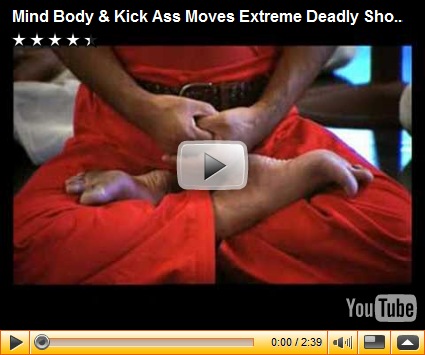
2. Mind, Body & Kickass Moves
This 10 episode series was initially broadcast on BBC Three and followed up by the Kickass Miracles series as well as the one-off Kickass in a Crisis. The show follows host, martial artist Chris Crudelli, around the Far East as he explores different martial arts (primarily, Chinese arts) – the main showcases are interspersed with Crudelli demonstrating martial arts-based tricks/magic to the UK public.
Pros: As the show aims to only introduce different arts, it is able to follow a wide range of masters and showcase their different methods of training. Furthermore, while Crudelli is wide open to the notion of chi, he is does place some critical comments in regards to some of the 'chi masters' (more so in Kickass Miracles). Lastly – there is actually a lot of good accurate information presented in a fairly true-to-life form.
Cons: The opening of the show states Crudelli is a 'master of combat and esoteric energies' – this is a sign of things to come! The show spends a great deal of time reminding us that Crudelli is a martial arts master (debatable since the point of the show is him visiting martial arts masters…); furthermore, the interspersed sequences make Crudelli look more like an arrogant, attention-hungry street magician than a humble martial arts master (a quick Wikipedia search will let you know that Crudelli was once an aspiring theatre artist …and it shows!).
1. Deadly Arts
This National Geographic show follows Aikido-ka Josette Normandeau around the world as she experiences what were some lesser known martial arts at the time (A second version of the show was filmed and hosted by Bollywood action star Akshay Kumar - who was a martial arts teacher before becoming an actor – Classic). Each episode focuses on one martial art in its home country with the host visiting different masters and then undertaking some form of final 'challenge' (not necessarily a fight). 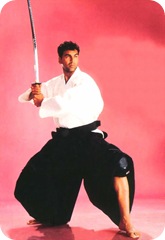
Pros: The show presents an honest take on every martial arts style examined (including child boxing in Thailand) – it does not look to flaunt the extreme nor mock what is not understood. It allows the viewer to objectively witness martial arts training and form their own opinions. Furthermore, the show pioneered later efforts such as Human Weapon and Fight Science. Lastly, not all the 'challenges' are fights (though some are) – this is a much truer representation of martial arts in my opinion.
Cons: Well, nothing's perfect. As well-meaning as she is, Josette Normandeau is unfortunately who lets the show down to some degree. Though I’m sure she is knowledgeable with 25 years of training behind her, she is also past her physical prime and thus unable to keep up  with a lot of the training, which in turn leads to a lot of whining followed by a predictable struggle to train for her upcoming challenge (which she inevitably passes – cue inspirational background music).
In truth, every resource has its strengths and weaknesses. Martial arts TV documentaries present some wonderful information but, be wary that most shows are from the perspective of an outsider looking in (potential victims of cultural relativism and ethnocentrism for you anthropology buffs) – don't use one show as the foundation of your knowledge or opinions. Read books instead (…yes, I said it!).
By the way…If anyone knows where I can watch the Deadly Arts with Akshay Kumar series, please do let me know!
Also known as ude garami in Judo; Sometimes called a Key lock, Figure-Four Armlock or Chicken Wing (which incidentally was the nickname of a good friend of mine when we were in school…nothing to do with martial arts, everything to do with the way he used to run).
The Americana is a basic submission where the arm is bent at around 90 degrees and twisted towards the head cranking the shoulder as well as applying a large amount of pressure to the elbow.
 This high percentage submission is most commonly performed from Side Control (usually, 'Four Point' Side Control) or from Mount; some practitioners are also very successful at applying the technique from the Top Half Guard position. It is also commonly used by many traditional Stand-Up systems as a basic lock/takedown against an incoming punch or downward 'stab' (a la Psycho).
The link below (they wouldn’t allow me to embed the video – sorry!) takes you to Gene Simco (whose name appears to be synonymous with controversy in the BJJ universe) explaining how to apply the Americana from the Closed Guard (with and without a Gogoplata variation – but if you already have a Gogoplata locked into place, why wrestle for an Americana as well? That's just greedy Mr Simco!):
Gene Simco Gogoplata/Americana from Guard Double Attack
The Americana was the first submission I worked on in a BJJ class. I had never been a fan of its Stand Up application as was taught to me in Karate and to be honest, I'm not a huge fan of the submission's application on the ground either! I just feel that that to really effectively use the submission, you need to be able to pin down your opponent's arm – given that many of my training partners are able to more or less bench press me with a single arm (no joke!), the technique for me just feels unstable/risky, more so from the Mounted position.
Even when on the receiving end, I find that the Americana is relatively easy to defend or counter against. I tend to notice that when it does work, it is more a case of brute force than technical expertise (I mean in general, not just with me) – it's bizarro twin, the Kimura, is a lot more threatening.
So why have I posted this article? Well, just because I can't work the technique as well as I'd like doesn’t mean it’s a 'bad' technique – it's one of the simplest and most commonly used submissions from Beginner to Black Belt level (or so I've been led to understand!). Furthermore, its application from Guard (which has a lower success rate) works well if you use it as a Sweep (its works wonderfully if you combine it with a Butterfly Hook).
Knowing is not enough,
We must apply.
Willing is not enough,
We must do.
~ Bruce Lee
A few weeks ago, out of curiosity, I signed up for a free trial of what claimed to be a 'no-nonsense guide to effective and easy self defence'. And sure enough, every few days for the past couple of weeks, I have received a new video tutorial 'teaching' me what are allegedly battle-tested, highly effective self defence techniques.
Now, here's the sad truth – it's mostly just a lot of nonsense; there is no easy fix to self defence. It's not something that can be learnt through watching ten videos online, nor is it something you can learn by attending a trendy two hour seminar. Here's why:
Fight, flight or freeze
The 'fight or flight' syndrome is our body's natural response preparing us to either 'confront' or 'flee' from a perceived threat. Physiologically, this is a result of our body's sympathetic nervous system inducing nerve cell firing and chemical releases (casually referred to as an 'adrenaline dump') that boosts the body’s ability to run away or fight. Typically as a result, the respiratory rates increase; blood is shunted away from the digestive tract and directed into muscles and limbs (i.e. more energy/strength); pupils dilate and impulses quicken (resulting in a 'slowing' of time and more focused line of sight); the immune system intensifies, and our ability to feel pain diminishes.
As wonderfully super heroic as the above sounds, an adrenaline dump is also accompanied by a severe decline in our fine motor skills (small, precise movements like using your car keys to unlock your door) as well as impairing our ability to make rational judgments – this is often what leads to a 'freeze'. Tunnel vision can sometimes also occur.
Since conscious judgement and fine motor skills are impaired, self defence responses must be instinctive, primarily relying on your gross motor skills (less precise movements such as pushing a swinging door open).
Self defence / martial arts are essentially training a Pavlovian response to situations of threat. Following extensive training fine motor skills can be used (mainly because of training techniques into 'muscle memory') and rational judgements can be made in the midst of an adrenaline dump to a certain extent however, there will always be a certain level of impairment by nature of our physiology.
As such many of the movements in 'quick-fix' self defence courses become inapplicable due to the requirement of fine motor skills (Exercise: Find a small spot on the wall and try to very quickly poke it 25 times returning your hands to your sides after each attempt…fidgety, right? Now imagine you were trying to do the same to someone's eye while disoriented, feeling the effects of an adrenaline dump, and while he viciously attacked you…). Furthermore for those techniques that are effective, a two hour course (even a two day course!) is simply not enough time to train an instinctive response.
Monkey Steals the Peach, Deity Picks the Grapes
Most self defence programmes promise something other than what is available in the general mainstream. Often these techniques have been lost in the annals of time or have been hidden from you by the government (or another such illuminati-esque organisation). However, there's no such thing as a secret technique (even if you believe in ki, classes are commonly accessible!). As humans we are all pretty much identical in an anatomical sense (the only difference is that between sexes) – that is, everyone (of the same gender) possesses more or less the same vulnerabilities.
True, different arts focus on different methods to target these vulnerabilities but ultimately, a punch is a punch – the important thing is finding something that complements you as an individual; something that you feel works for you (as well as something you enjoy – cause if you hate it, chances are you won't stick with it!).
Battle of the Sexes
No doubt this final point has the potential to generate a fiery backlash but it does need to be mentioned. In general, men are naturally bigger and stronger than women. And in most self defence cases involving women, men tend to be the attackers (this doesn't include street fights though). Simply put, defending yourself against a bigger and stronger assailant is hard; it takes a significant amount of earnest training to handle someone who is much stronger than you (even if he/she has no clue about martial arts), especially if they are seriously trying to hurt you.
Size matters. Don't expect to be able to easily handle an attacker after two months of training. Size matters…but only so much. With regular training over a long period of time you will be able to handle bigger, stronger (untrained) attackers. For example, I'm usually one of the smallest, physically weaker fighters wherever I go – this doesn't mean that I'm constantly losing but, it does mean that I have to make sure to constantly train harder than people who are more naturally athletic.
The Art of Fighting Without Fighting
The best form of self defence is no self defence at all. Just as it is safer to move completely out of a punch's trajectory, it is safer to avoid situations where you will need to defend yourself. You don't need to be a hermit to do this, just follow some simple safety tips (that said, nothing is for certain – be prepared!). Have a look at this Personal Protection website:
http://defence.dsu.org.uk/
The website is tailored to female university students but the information available is applicable to most people (should you browse the 'Past Instructors' section, please do excuse the horrible photograph of me; I don't usually look like I've been pulled out of a cartoon).