One of the earliest posts I wrote on this blog was The Triangle Hypothesis, which talked about three facets key to improving as a martial artist or fighter. For those of you who've read it, you may remember that I chose to add 'C' to the 'triangle' that many past instructors of mine had related to me. The C in this case stood for Cardio & Conditioning. The logic behind my decision was that without the right levels of fitness and body conditioning, you would be unable to fully utilise the three corners of the triangle that are Power, Speed, and Technique. This post intends to elaborate that view.
It's not by sheer randomness either - While rolling last night (my first night back! *sigh*), I was caught in a surprise Achilles ankle lock (and took a nasty elbow to the brow) and as a result, walking just doesn't feel right anymore – but instead of depressing you (my ever-emphatic reader) with a post about how my leg hurts or about how my eye looks like I was the loser of the Thriller in Manila; I'm going to write about my clever improvement of my instructors' theory with C (even though I'm pretty sure most of them just assume that C is a given).
"Minds, like bodies, will fall into a pimpled, ill-conditioned state from mere excess of comfort."
- Charles Dickens
It's no secret that the more time you spend on the mats (whether rolling, stand-up sparring or drilling), the faster you will improve. And we always hear how martial arts (especially those considered 'Traditional' styles) are all about Technique being used to overcome Athleticism, so then why have I devoted an entire post to Cardio/Conditioning? The answer in short, is that unless you have vastly superior technique to everyone else – your endurance and conditioning is going to play a factor. 
If you're looking to excel in competition (you old glory hound, you), stamina is clearly needed as you'll have to spar several rounds with relatively little rest in-between. Furthermore, if you like competing in the Absolute division (or equivalent weight-free zone), it's possible that you'll be sparring against bigger, stronger opponents who will sap the stamina out of you! There's little you can do when you're completely drained of energy against a well-trained bigger, stronger opponent so the best option is to train hard before the competition to ensure it doesn't happen.
"The time to repair the roof is when the sun is shining."
- John F. Kennedy
Non-competitive types need to be wary of the same points. You may not be competing at tournaments but note that the competition format is pretty similar to sparring sessions in training. If you don't have a high level of stamina, you won't be able to train as efficiently – i.e. Half of your 2 hour training session is wasted if you only manage to train hard for 1 hour before gassing. Though some of you may here point out that training isn't about all about 'quantity' but rather 'quality'…and you're right. However, once you begin to fatigue, your technique without a doubt begins to slowly deteriorate and while training at this point is arguably still beneficial (any training is better than none in my opinion), it is less efficient (the exception here is when you intentionally fatigue your body so as to limit your use of strength and to focus on working techniques).
And as an old boxing coach used to tell me: physical fitness improves 'mental toughness'. But is that enough? Sadly, no – as martial artists, our training all too often focuses on 'dishing out' while we spend relatively little time conditioning ourselves for the more unpleasant reverse scenario of being the 'main dish' (also quoting my old boxing coach).
In fact, I'll just explain it to you the way the old man would rant about it to me (minus some explicit wisdom)! It helps to know that Coach A was appalled by modern boxing tactics where boxers 'dance around' and 'play for points', he was a staunch believer that you punch for the knockout ("There's no such thing as a jab" he'd say).
Exercises to toughen the body have been all but forgotten. Competition has led to extensive cardio training so that fighters can last entire fights (most of which are spent running in every direction except towards your opponent). Exercises to toughen the body to withstand the rigours and demands of training and combat have been more or less discarded. Coach A used the example that most boxers have never boxed without heavy gloves and thorough wrapping – how's one expect to condition their  hands if they're wrapped up and then further protected by a fat padded glove? Jack Dempsey makes a point of it in his book Championship Fighting: Explosive Punching and Aggressive Defense, urging the rookie boxer to train with ‘striking gloves’ or by “snipping the fingers of a pair of leather work gloves” so that he can condition his fists.
Martial arts such as Karate require even more conditioning to deal with tackles and attacks below the waist. Furthermore, developing the ability to withstand the constant (but minor) injuries sustained in training is paramount as it to an extent, dictates the level of confidence you have in the said art – so hit that makiwara until it apologises to you!
The Best Way to Cardio and Conditioning
This is one of those obvious points that's so obvious people don't notice it. The best way to develop the required stamina and conditioning for your martial art is simply to train…a lot! Not only does that ensure that you'll be developing your body in a natural way that complements your art but, you'll be doing it via means that you already love doing (the assumption here is that you enjoy training)! Make sure to train hard and push yourself in all aspects of your art, otherwise you may find your body woefully underprepared later… and please make sure to properly warm-up, stretch, and cool-down. Here's a clip of Goju Ryu 10th dan Morio Higaonna – he uses a rock to condition his fists… He's a scary man (though apparently a really nice guy too!).
The next best thing…
If you're gym/dojo/basement happens to be closed, you're a little shy about training in the park, and no one is around to play sports with, there are plenty of other options. Main thing – find something challenging that you enjoy. Personally, I hate elliptical and body building machines so I steer clear of them. Instead I prefer to swim (with the occasional bit of underwater karate when the coast is clear!) or go for runs at varying speeds (undisciplined interval training). One of my training partners hates exercise and formal workouts; he instead chooses to dance on days off from the dojo – I've joined him a couple of times… two hours of salsa/hip hop is surprisingly hard work!
Dieting
Though I know plenty of people that are constantly dieting in order to make weight, I'm not really a fan of the process. Personally, I think it’s better in the long run to follow some healthy eating habits and maintain a weight that is natural to your body even if it means that you end up at the bottom of your weight category – after all, why would anyone really want to fight someone much smaller than them (unless the ickle opponent is an absolute badass)?
Recovery Time
Whatever means of cardio and conditioning you choose, make sure to get in ample recovery time. Not only will this help your absorb information/techniques faster but it will allow you to perform at a higher rate with a lower risk of injury. And yes, sometimes you'll just need a week or two out from training – don't worry about losing the short term training as taking time off not only helps you recuperate but, it also allows your body to fully assimilate the training you have done recently (just be sensible about how often you take time off).
*Sigh!*
You may have noticed that I've used more boxing references than I usually do in this post. It's because my head is still going over Amir Khan's defeat of Marco Antonio Barrera from last week. The "Baby-faced Assassin" (Barrera) is one of my favourite boxers and it's sad to see him dominated (though I suppose I must admit, he has been on the decline for some time now). Ah well…c'est la vie!
I’ve had a pretty lame week. Not only have I been unwell, unable to train, and stuck in the office for 16 hour shifts (no kidding!)…I’ve also been craving a particular type of cupcake, which I just can’t seem to find! However, this made it all better for me.
On March 8th, Shinya Aoki and David Gardner duked it out in Saitama (Japan) for the opening round of the Dream 7 Featherweight Grand Prix. Aoki (“The Baka Survivor”) has already made a huge name for himself, and Gardner (forevermore known as "Hello Japan") isn’t completely unknown either.
The Dream 7 event failed to pull in high viewer ratings, but the fight finisher between Aoki and Gardner will be on highlight reels for years to come.
Wow…
Look at it this way, at least Gardner got to say hello before the fight ended (I love the fact that the commentator says “Goodbye Japan!” during the tap out)!
There are a myriad of martial arts documentary shows available to watch on television – some of them are great references for information, others less so (but still massively entertaining). References from these shows are thrown around the dojo quite often so I thought I'd post an article about what I believe to be the Top 5.
I'll just clarify that this post is only referring to martial arts series that have hit the mainstream; and I'm not looking at stand-alone documentaries (for example, Myths & Logic of Shaolin Kung Fu). And of course, this list is completely subjective so I'll attempt to briefly explain why I choose the shows I do. Feel free to disagree!
5. Fight Science
Initially planned as a stand-alone documentary, the show spawned three direct spin-offs titled, MMA, Special Ops: Super Soldiers, and Self Defence; as well as a dreadful ‘documentary’ based on the initial premise, dramatically entitled Kung Fu Killers: Top 10 Kung Fu Weapons.
Pros: The Fight Science series has been a mega hit with audiences. It has generated a huge awareness for martial arts and the capabilities of martial artists. It also attempts to tackle 'Martial Arts Myths' and the 'Which style is best?' question using scientific tests making it fairly unique – it was also the first show to use motion capture technology to explain techniques.
Cons: The biggest names on the show (Rickson Gracie, Dan Inosanto) were woefully underutilised. The scientists unfortunately have just about no knowledge regarding the martial arts (and also lack some common sense) in that they expect to be able to make a linear comparison between almost randomly selected practitioners! For example, comparing the punching power of an ex-pro heavyweight boxer with that of a lightweight kung fu forms champion is just silly! The follow-up episodes rectified this to an extent by testing the abilities of the individuals (and it's always amusing to see Bas Rutten flirting with some scientist in awe) though the tests/conclusions remained heavily flawed and unempirical. Actually…I could go on for pages on how poorly the tests were conducted – either way, it's an entertaining show with some interesting results…just watch it realising that the scientists don't really know what they're testing!
4. Human Weapon
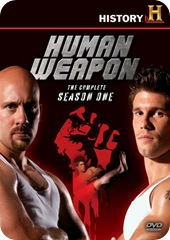 Aired on the History Channel, this was the revival of the martial arts travelogue. It lasted one season and involved the hosts travelling to a country to study its native martial art (in the form of a couple of basic techniques from different instructors) culminating in a 'fight' against a champion of the represented style.
Pros: Introduced many viewers to some lesser known martial arts; the show uses motion capture technology to help explain the major techniques taught to the hosts in each episode. Furthermore, Justin Chambers is a likeable host who, as an MMA representative, adds a sense of modernity to this otherwise old-school (anyone spot the clever BJJ reference?) format.
Cons: Bill Duff has absolutely no clue what he's talking about and often misquotes and misrepresents the episode's style – he also comes off as a bit of an ass. Furthermore, most of the final fights are intentionally toned down so as not to embarrass either the hosts or their opponents, which ends up misrepresenting the abilities of fighters on both parties (I mean, the Duffster only gets knocked out by the semi-contact TKD fighter? He even makes it sound like he's done well cause he's scrapped his knuckles in a Kyokushin match – even though that’s just a sign that his hands are poorly conditioned!).
(Oh, and the show has a lot of conservative undertones that don't really affect its quality but do bug me a little…)
3. Fight Quest 
Though it was filmed before Human Weapon, Fight Quest began airing on the Discovery Channel after Human Weapon had started on the History Channel. Similar in format to the aforementioned show except that the hosts (Jimmy Smith, veteran MMA fighter; Doug Anderson, US army veteran and rookie MMA fighter) are split up for five days while they train under two separate masters.
Pros: Both hosts are more open-minded and their willingness to learn, as well as to admit to their own shortcomings, is refreshingly clear to see. Spending five days learning from a single teacher allows the viewer to have a better understanding of the respective art and its training.
(…Watch the Krav Maga episode to see some seriously damaged people – poor Doug!)
Cons: The show intentionally chooses to showcase extreme forms of training and tends to ignore showing more conventional training methods – this tends to make styles seem somewhat inaccessible; it also reinforces stereotypes of mysticism or that one style is more 'hardcore' than another.
2. Mind, Body & Kickass Moves
This 10 episode series was initially broadcast on BBC Three and followed up by the Kickass Miracles series as well as the one-off Kickass in a Crisis. The show follows host, martial artist Chris Crudelli, around the Far East as he explores different martial arts (primarily, Chinese arts) – the main showcases are interspersed with Crudelli demonstrating martial arts-based tricks/magic to the UK public.
Pros: As the show aims to only introduce different arts, it is able to follow a wide range of masters and showcase their different methods of training. Furthermore, while Crudelli is wide open to the notion of chi, he is does place some critical comments in regards to some of the 'chi masters' (more so in Kickass Miracles). Lastly – there is actually a lot of good accurate information presented in a fairly true-to-life form.
Cons: The opening of the show states Crudelli is a 'master of combat and esoteric energies' – this is a sign of things to come! The show spends a great deal of time reminding us that Crudelli is a martial arts master (debatable since the point of the show is him visiting martial arts masters…); furthermore, the interspersed sequences make Crudelli look more like an arrogant, attention-hungry street magician than a humble martial arts master (a quick Wikipedia search will let you know that Crudelli was once an aspiring theatre artist …and it shows!).
1. Deadly Arts
This National Geographic show follows Aikido-ka Josette Normandeau around the world as she experiences what were some lesser known martial arts at the time (A second version of the show was filmed and hosted by Bollywood action star Akshay Kumar - who was a martial arts teacher before becoming an actor – Classic). Each episode focuses on one martial art in its home country with the host visiting different masters and then undertaking some form of final 'challenge' (not necessarily a fight). 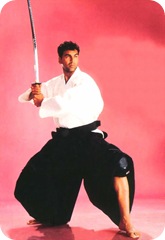
Pros: The show presents an honest take on every martial arts style examined (including child boxing in Thailand) – it does not look to flaunt the extreme nor mock what is not understood. It allows the viewer to objectively witness martial arts training and form their own opinions. Furthermore, the show pioneered later efforts such as Human Weapon and Fight Science. Lastly, not all the 'challenges' are fights (though some are) – this is a much truer representation of martial arts in my opinion.
Cons: Well, nothing's perfect. As well-meaning as she is, Josette Normandeau is unfortunately who lets the show down to some degree. Though I’m sure she is knowledgeable with 25 years of training behind her, she is also past her physical prime and thus unable to keep up  with a lot of the training, which in turn leads to a lot of whining followed by a predictable struggle to train for her upcoming challenge (which she inevitably passes – cue inspirational background music).
In truth, every resource has its strengths and weaknesses. Martial arts TV documentaries present some wonderful information but, be wary that most shows are from the perspective of an outsider looking in (potential victims of cultural relativism and ethnocentrism for you anthropology buffs) – don't use one show as the foundation of your knowledge or opinions. Read books instead (…yes, I said it!).
By the way…If anyone knows where I can watch the Deadly Arts with Akshay Kumar series, please do let me know!
I had initially planned to write a post regarding both the 'Achilles Ankle Lock' and the 'Knee Bar' but then I remembered Stephen Kesting's GrappleArts website already has a fantastic article dedicated to each of these techniques.
I'd be depriving you if I tried to explain the techniques myself when there is already a much better resource available. So here are the links:
http://www.grapplearts.com/Ankle-Lock-Breakdown.htm
http://www.grapplearts.com/Kneebar-Mastery.htm
Personally, I find that the Achilles Lock is far too easily countered for me to go for it. The Knee Bar is an effective move but quite a difficult one to apply in my opinion.
Previous Leg Lock: Toe Hold Ankle Lock

Sometimes referred to simply as a ‘Foot Lock’, the Toe Hold Ankle Lock is a submission that is applied via the twisting and applying torque around one’s instep and the axis that runs along the centre of the foot.
It is easy to apply and worlds safer than the Heel Hook; as such, it is the second most frequently used ankle lock (following the Achilles Lock) and probably one of the most popular leg locks used.
The submission is applied using both your arms. In the case of applying the submission to your opponent’s (who has his/her back to the ground) right leg, your right arm grasps his right foot with your hands placed over his toes (your fingers should be curling in below his foot). Your left hand should move in front of his shin and wrap around his leg (thus encircling it with your arm) and then grab on to your right wrist using a five finger ‘monkey’ grip. Using the left arm as a fulcrum, apply pressure by pushing down on the foot/turning your body and twisting the toes towards your opponent’s groin.
Here it is explained by Bas Rutten in his 'Leglocks & Legbars' instructional video:
Key Points to Remember:
- You’re not grabbing his toes, you’re encasing them.
- The monkey grip may feel awkward at first but it is a lot more secure than a standard ‘four fingers + thumb’ grab. Given the size of leg muscles, you’re going to need a secure grip!
- Make sure to pay attention to his free leg, the fight may end badly if he lashes out with kicks.
Here are a few of my favourite transitions to the Toe Hold Ankle Lock:
- Whilst passing your opponent’s guard
- From an incomplete Omoplata set-up, or ‘Jiu-Claw’
- From just about any X-Guard sweep
- Whenever you’re in a scramble!
The submission however presents some simple escapes/counters and as such is relatively difficult to use against experienced practitioners. The most common escape is simply turning your body in the direction of the torque; an attempt I made some days ago was countered by my partner stacking/rushing into me and applying a neck crank. My personal preference is to counter the lock with a heel hook.
Previous Leg Lock: The Heel Hook
Next Leg Lock: Achilles Ankle Lock & Knee Bar
A neck crank (or a ‘cervical lock’ for the pedantic amongst you) is a spinal lock applied to the cervical spine (your neck) by pushing, pulling or twisting it in a direction it doesn’t want to go. ‘Clickity clack’ is usually a sound associated with a successful neck crank and while in the grander scheme of things, only a small percentage of submissions are the result of a neck crank, they remain feared due to their potential to cause serious injury (…no explanation needed).

There are a wide variety of neck cranks in most martial arts and all are fairly dangerous. Most BJJ competitions forbid cranking the neck although it is still permitted in Judo, Wrestling and other grappling competitions. The technique is often used by beginners as well as advanced practitioners as its application can be as simple as the ‘Can Opener’ or more complex like the ‘Twister’ (otherwise known as the wrestlers’ Guillotine) or the Crucifix Neck Crank.
Here’s a video tutorial by Submissions 101 of the basic 'Can Opener' neck crank:
Key Points to Remember:
- A fairly low percentage submission; consider using it to break someone’s guard.
- Keep both your elbows tucked close to one another on your opponent’s chest.
Traditionally, the can opener has a relatively low success rate. In most instances, people use it to break someone’s Closed Guard. That said, it is remarkably simple to apply and I’ve been caught in it (usually when I’m stuck under someone’s Mount) more times than I care to mention (look at the title of this post to get an idea how the neck crank plagues me!)!
Below Bas Rutten demonstrates another neck crank from Side Control (technically, Scarf Control). A senior at my gym loves this move, and speaking from experience – it is ridiculously painful. An alternative counter to that explained by Bas in the video is to pull the knee of your free leg up by the side of your head and then kick it up and drop it in front of your opponent’s face/neck and push out (there’s a submission here if you angle yourself correctly).
Following the rise of Mixed Martial Arts (MMA), many Traditional Martial Arts fell under heavy scrutiny for their relative inability to prove their effectiveness in what is possibly the closest mainstream simulation to no-holds-barred street fighting. Early UFC events saw Royce Gracie (and the then relatively unknown art of Brazilian Jiu Jitsu) tapping out opponents from a variety of martial disciplines - many of whom had what were considered to be vastly superior physical attributes. Representatives of Karate, Kung Fu, Boxing, and Tae Kwon Do seemed to be outmatched by their grapple-savvy opponents 9/10 times.
As the rules of MMA evolved (became tamer so as to capitalise the main stage via the pay-per-view bandwagon), a new breed of fighters started to dominate - stand-up fighters who had branched out to complement their striking skills with an effective ground game (or at least enough of one, to sully the submission and positional dominance that the 'pure' submission artists had thus far possessed) but still, representatives from TMA styles continued to provide a poor performance (it is only recently that TMA-based fighters who have branched their skills are coming out on top – though little credit is given to most of their traditional base styles).

The weak performance by those alleged to be top level traditional martial artists in the UFC (coupled with the rising McDojo trends in the US and elsewhere) led to the development of a widespread belief that TMAs are outdated (at best! others claim they were useless from the start). But why? Could the mechanics of a punch or a kick really have changed that much in the last hundred years? In truth, techniques haven't changed (not to any significant degree anyways) - true, people don't have the same lifestyles, or wear armour as was done in the past, but this only serves to make TMAs more effective (no longer a protective barrier to work around/through).
The crux of the matter is this. The standard of martial arts training in the mainstream has fallen. Here are some of the factors leading to this:
- 'McDojos' which focus on turning a profit rather than actually teaching the student.
- Unrealistic training - usually the fault of the instructor who doesn't bother to teach students how to apply their training.
- Encouraged Laziness - many MA schools teach one hour classes, twice a week....progress is going to be VERY slow (moreso, if the students are not encouraged/forbid to train outside of class whether it be at a second club or solo) and this is nowhere near enough time to condition and train the body while also training techniques.
- Unqualified Teachers - I've actually met Karate teachers who've had literally 2 weeks of training. No joke (Needless to say - not only do they provide poor instruction, they are also useless examples).
MMA has raised awareness in TMAs. Less than 15 years ago, McDojos were only really recognised by experienced martial artists/fighters - now a much wider audience is able to see the amount of hard work martial arts really require, and though many are still only interested in a quick black belt, many more realise that half-hearted training is little more than a rhythmic delusion. Royce Gracie put it quite nicely, "A belt only covers two inches of your ass, and the rest you need to back up on your own."
TMA practitioners are reminded of the need for realistic application and body conditioning as well as regular training routines. MMA reminds TMA that a black belt means only that, a black belt - if you want to defend yourself, if you want to fight... the colour of your belt will have little effect on anything. The only thing that will help you is training, not just repetition. Remember: Practice doesn't make perfect...Perfect practice makes perfect.
( Note: Depending on the art, there are many levels of black belt. A shodan - 1st degree - generally means that the student has become proficient with the basics of the art ...don't be fooled into thinking that black belts are necessarily all masters! I know I'm certainly not! )
PS: Happy New Year Everyone! :-)
Not so long ago, terms such as 'Karate' or 'Kung Fu' were synonymous with self defence. Indeed a black belt was revered as a master of what appeared to be mystical arts showcasing inhuman feats of strength, aggression, and agility - maybe that's a slight exaggeration, but the belief that black belts could defend themselves to almost superhuman levels was fairly widespread.
The MMA scene reduced these superhumans to mere mortals wearing funny white pyjamas...some of these masters became laughing stocks for the world to see. People became hugely sceptical of the vast majority of Traditional Martial Arts (especially any 'Internal' Arts), which was only natural given the situation and frankly, a lack of public understanding regarding martial arts, sport combat, and self defence scenarios.
Though, I'm sure this issue must have by now been addressed in-depth by a plethora of knowledgeable martial artists more articulate than me, I'm going to explain the topic from my understanding. MMA fighters are immensely talented individuals; the sport is easily one of the most demanding of those commonly practiced in the world today. However, MMA (really, I mean Combat Sport in general) is not self defence training - MMA is a rule set.
The Basics
Let's start by examining the differences between ring fighting and a simple brawl. In my opinion the key difference is 'emotional content' (as phrased by Bruce Lee). While aggression and getting fired up is common in MMA, they are not akin to the anger and the intent as presented in a self defence situation. A MMA fight is not personal (in most cases!), self defence is nothing but personal - allow me to clarify at this point, a fight is not self defence; a fight (even just a drunken street fight) requires both (or more) parties to, at least subconsciously, agree to the confrontation.
Self defence revolves around survival - it is the necessary response to an attack of malicious intent. The victim (for lack of a more apt term) is not in the mental mindset to fight. As such, self defence isn't about winning, it's about not losing (...your life).
(Of course, I fully concur that what starts as self defence can easily develop into a fight, and that fight can then continue into an attack on the original attacker once the 'fight' is over. But I think the point at hand is clear...)
The devastating effects of a 'sucker punch' are well-known. World class fighters have been knocked unconscious by an unexpected punch before or after their fight - in many of these occasions, the so-called 'knockout punch' would hardly have phased the fighter during the course of the fight (probably because of the adrenaline dump powering him on) - a clear warning isn't always available in street encounters. This leads to the next factor, matchmaking.
All Combat Sports involve some form of preceding matchmaking. Matches are usually made according to weights and comparative abilities. For example, you would be matched against someone of around the same weight (5-10 lbs either way) and of a relatively comparable skill level in order to ensure the safety of fighters as well as in hopes of securing an exciting match. i.e. If I became an MMA competitor, I wouldn't have to ever worry about fighting Fedor unless he or I respectively lost or gained substantial weight (and I by some miracle was deemed to be worthy of the Fedor's fists).
Destiny/Luck (or lack thereof;) is what determines your opponent in a self defence situation (and to some extent in a 'standard' street fight/brawl) - you could be fighting a 'moronic meathead' (standard training dummy) or you could be positioned against a trained fighter on amphetamines.
Combat Sports prepare you to focus exclusively on your opponent and ignore any distractions occurring outside of the ring/octagon/mats etc -not a very helpful skill should any passerby/witness choose to join in the attack (scarily, this is a relatively common occurrance!). You are prepared to react only when you know an attack is coming; your guard is already up. Street situations do not allow for this luxury, which is why most traditional martial arts dedicate years to slowly cultivating a state of relaxed alertness, referred to as Zanshin ("remaining mind") in Japanese arts. Jean-Claude Van Damme famously positioned himself for a barrage of insults following his Franglais assertion, Je suis AWARE.
Of course, Zanshin isn't quite a Spidey Sense - it is simply a healthy awareness of one's surroundings developed through training different forms of kumite ("sparring") and other such exercises. It is not a trait exclusive to Japanese martial arts practitioners by any means; most seasoned bouncers and security personnel develop zanshin unconsciously whilst on-the-job.
Self defence (or street fights in general) do not involve any kind of regulations - the gloves are off (pardon the pun) and anything is legal. Biting, pinching, eye-gouging, hair pulling and striking to the groin are examples that scratch the surface of the attack possibilities present in a street fight than do not coincide with MMA training. I'm not suggesting that MMA fighters are unable to perform these techniques, I'm saying that such techniques may be less instinctive to an MMA fighter than to say, a Krav Maga expert (...that said, Krav Maga in my opinion, is one of those few styles that can easily result in the victim being given a longer prison sentence than the assailant).
Furthermore, there is no determined time limit to the fight. While most fights are believed to last between 90 and 180 seconds (longer when groups are involved), most self defence situations are resolved (for good or bad) within a minute.
Remember: A situation can end following a simple slip of the feet; there is no canvas ring/octagon - one could hit his head on the curb. Many deaths have occurred from falls in street fights.
Let's talk about equipment - most safety equipment used in combat sports is for the sake of both fighters. Wearing gloves reduce the risk of breaking your knuckles or hand-bone (in case the punch lands on your opponent's elbow or square on his forehead); gloves also provide support to the wrists which are known to buckle under impact or falls. When on the receiving end, gloves reduce the risk of being cut or breaking any facial bones; while increasing the chance of being knocked out - in fact, this was one of the primary reasons to introduce heavier gloves into boxing. Prior to this, many of the blows that now usually result in knockouts would more likely result in broken teeth, cheekbones, noses...but no knockout.
There is also a factor of the equipment not used in MMA - knives, guns, bats, bottles, chairs etc. Regardless of one's training, a weapon in the attacker's possession always complicates matters - relatively speaking, very few people (even those trained in weapon-based styles) would feel comfortable when the pointy end is facing them. Whilst many martial artists may have some experience training against weapons (or at the least, understand how the rules of a fight change completely when weapons are involved), pure Combat Sport fighters have no experience in such occurrences (unless they've looked into it personally).
Groundfighting in Self Defence
Groundfighting (while necessary to know...to an extent) is its own jar of sour pickles when it comes to self defence. For a start, on the ground you're vulnerable to damage from anything that's on the ground - if you're in a bar or club, this could involve broken bottles; or if you're on the roadside, this could be sharp rocks or sand getting kicked in your face.
Tackling multiple assailants whilst standing is an impressive feat - even if you're not able to beat them, you may be able to bump and shove them before making a dash (...you could always take a page out of Musashi's book and try fighting them in a doorway or narrow alley...though this is tenuous at best) - Doing it whilst on your back is a near impossibility (unless your assailants are completely and utterly incompetent...no, I mean more hapless than those guys from the Home Alone movies - what? it's Christmas, it's on TV all the time) - even Rickson Gracie made the clear point that if you roll with two guys that are determined to beat you, one way or another you're going to lose (I should point out here though, that he also stated that if you use BJJ correctly, in most self defences situations - you'll remain standing whilst your assailant is 'rolling'). Groundfighting is great on the mats, but realise that it is learnt only as a necessary precaution in self defence.
And I say the following out of pure speculation (but it makes some sense to me): If it is a female that has been attacked in what could be a potential rape situation, pulling the attacker into closed guard may only arouse him more - certainly, the arousal may be short-lived if the defender breaks his arm a moment later but, I imagine that short period of arousal against the woman's body may leave some emotional scarring that simply kicking your attacker in the balls and running away would not. ...Just speculation....This of course won't be true in many cases....
The Disclaimer
This is the part where I tell you that I have absolutely nothing but respect and admiration for Mixed Martial Arts and its practitioners. I'm not saying in any way that MMA isn't effective in self defence - in many ways, MMA practitioners are much more prepared for self defence situations than many so-called TMA artists. MMA practitioners tend to have higher levels of fitness and better body conditioning as well as being accustomed to the full contact nature of street encounters (though randori or jissen are often talked about, relatively few TMA schools really devote sufficient time to their training - though I hasten to add, this doesn't necessarily refer to no time limit, no-holds-barred-to-the-death-style training...but rather to training techniques in a variety of situations against a moderately resisting opponent who is able to counter and/or break attempts at attack).
I'm not interested in arguing which is better - that's really just a matter of personal opinion as to which discipline better fulfils your personal goals (the assumption of a linear comparison is not really well thought out anyways). Personally, I see relatively little difference between MMA and TMA - to me, MMA isn't really a style of martial arts but rather the utilisation of different aspects of TMAs to function under a rule set (I'm not too fond of these new guys who have no background in any one style/particular strength but are just 'okay' at everything...).
The major difference I find is that TMA's are not for fighting - they are primarily for self defence. As such, they both have extraordinarily different learning curves (that is, MMA can be learnt faster but will not help you as much when you get older; TMAs are much slower to learn but can still be very effectively utilised when you've passed your physical prime).
Fighting is an integral aspect to both disciplines, but for TMAs, it is something that follows self defence - it does not define 'self defence'. And that's really the message I'm trying to get across in this very long post. While Combat Sports can be very effective for self defence, their practices are not an example of self defence; there are other effective options available given that they are trained correctly.


