There are a myriad of martial arts documentary shows available to watch on television – some of them are great references for information, others less so (but still massively entertaining). References from these shows are thrown around the dojo quite often so I thought I'd post an article about what I believe to be the Top 5.
I'll just clarify that this post is only referring to martial arts series that have hit the mainstream; and I'm not looking at stand-alone documentaries (for example, Myths & Logic of Shaolin Kung Fu). And of course, this list is completely subjective so I'll attempt to briefly explain why I choose the shows I do. Feel free to disagree!
5. Fight Science
Initially planned as a stand-alone documentary, the show spawned three direct spin-offs titled, MMA, Special Ops: Super Soldiers, and Self Defence; as well as a dreadful ‘documentary’ based on the initial premise, dramatically entitled Kung Fu Killers: Top 10 Kung Fu Weapons.
Pros: The Fight Science series has been a mega hit with audiences. It has generated a huge awareness for martial arts and the capabilities of martial artists. It also attempts to tackle 'Martial Arts Myths' and the 'Which style is best?' question using scientific tests making it fairly unique – it was also the first show to use motion capture technology to explain techniques.
Cons: The biggest names on the show (Rickson Gracie, Dan Inosanto) were woefully underutilised. The scientists unfortunately have just about no knowledge regarding the martial arts (and also lack some common sense) in that they expect to be able to make a linear comparison between almost randomly selected practitioners! For example, comparing the punching power of an ex-pro heavyweight boxer with that of a lightweight kung fu forms champion is just silly! The follow-up episodes rectified this to an extent by testing the abilities of the individuals (and it's always amusing to see Bas Rutten flirting with some scientist in awe) though the tests/conclusions remained heavily flawed and unempirical. Actually…I could go on for pages on how poorly the tests were conducted – either way, it's an entertaining show with some interesting results…just watch it realising that the scientists don't really know what they're testing!
4. Human Weapon
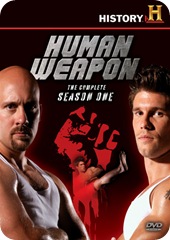 Aired on the History Channel, this was the revival of the martial arts travelogue. It lasted one season and involved the hosts travelling to a country to study its native martial art (in the form of a couple of basic techniques from different instructors) culminating in a 'fight' against a champion of the represented style.
Pros: Introduced many viewers to some lesser known martial arts; the show uses motion capture technology to help explain the major techniques taught to the hosts in each episode. Furthermore, Justin Chambers is a likeable host who, as an MMA representative, adds a sense of modernity to this otherwise old-school (anyone spot the clever BJJ reference?) format.
Cons: Bill Duff has absolutely no clue what he's talking about and often misquotes and misrepresents the episode's style – he also comes off as a bit of an ass. Furthermore, most of the final fights are intentionally toned down so as not to embarrass either the hosts or their opponents, which ends up misrepresenting the abilities of fighters on both parties (I mean, the Duffster only gets knocked out by the semi-contact TKD fighter? He even makes it sound like he's done well cause he's scrapped his knuckles in a Kyokushin match – even though that’s just a sign that his hands are poorly conditioned!).
(Oh, and the show has a lot of conservative undertones that don't really affect its quality but do bug me a little…)
3. Fight Quest 
Though it was filmed before Human Weapon, Fight Quest began airing on the Discovery Channel after Human Weapon had started on the History Channel. Similar in format to the aforementioned show except that the hosts (Jimmy Smith, veteran MMA fighter; Doug Anderson, US army veteran and rookie MMA fighter) are split up for five days while they train under two separate masters.
Pros: Both hosts are more open-minded and their willingness to learn, as well as to admit to their own shortcomings, is refreshingly clear to see. Spending five days learning from a single teacher allows the viewer to have a better understanding of the respective art and its training.
(…Watch the Krav Maga episode to see some seriously damaged people – poor Doug!)
Cons: The show intentionally chooses to showcase extreme forms of training and tends to ignore showing more conventional training methods – this tends to make styles seem somewhat inaccessible; it also reinforces stereotypes of mysticism or that one style is more 'hardcore' than another.
2. Mind, Body & Kickass Moves
This 10 episode series was initially broadcast on BBC Three and followed up by the Kickass Miracles series as well as the one-off Kickass in a Crisis. The show follows host, martial artist Chris Crudelli, around the Far East as he explores different martial arts (primarily, Chinese arts) – the main showcases are interspersed with Crudelli demonstrating martial arts-based tricks/magic to the UK public.
Pros: As the show aims to only introduce different arts, it is able to follow a wide range of masters and showcase their different methods of training. Furthermore, while Crudelli is wide open to the notion of chi, he is does place some critical comments in regards to some of the 'chi masters' (more so in Kickass Miracles). Lastly – there is actually a lot of good accurate information presented in a fairly true-to-life form.
Cons: The opening of the show states Crudelli is a 'master of combat and esoteric energies' – this is a sign of things to come! The show spends a great deal of time reminding us that Crudelli is a martial arts master (debatable since the point of the show is him visiting martial arts masters…); furthermore, the interspersed sequences make Crudelli look more like an arrogant, attention-hungry street magician than a humble martial arts master (a quick Wikipedia search will let you know that Crudelli was once an aspiring theatre artist …and it shows!).
1. Deadly Arts
This National Geographic show follows Aikido-ka Josette Normandeau around the world as she experiences what were some lesser known martial arts at the time (A second version of the show was filmed and hosted by Bollywood action star Akshay Kumar - who was a martial arts teacher before becoming an actor – Classic). Each episode focuses on one martial art in its home country with the host visiting different masters and then undertaking some form of final 'challenge' (not necessarily a fight). 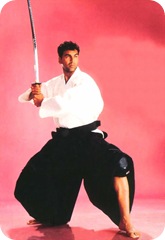
Pros: The show presents an honest take on every martial arts style examined (including child boxing in Thailand) – it does not look to flaunt the extreme nor mock what is not understood. It allows the viewer to objectively witness martial arts training and form their own opinions. Furthermore, the show pioneered later efforts such as Human Weapon and Fight Science. Lastly, not all the 'challenges' are fights (though some are) – this is a much truer representation of martial arts in my opinion.
Cons: Well, nothing's perfect. As well-meaning as she is, Josette Normandeau is unfortunately who lets the show down to some degree. Though I’m sure she is knowledgeable with 25 years of training behind her, she is also past her physical prime and thus unable to keep up  with a lot of the training, which in turn leads to a lot of whining followed by a predictable struggle to train for her upcoming challenge (which she inevitably passes – cue inspirational background music).
In truth, every resource has its strengths and weaknesses. Martial arts TV documentaries present some wonderful information but, be wary that most shows are from the perspective of an outsider looking in (potential victims of cultural relativism and ethnocentrism for you anthropology buffs) – don't use one show as the foundation of your knowledge or opinions. Read books instead (…yes, I said it!).
By the way…If anyone knows where I can watch the Deadly Arts with Akshay Kumar series, please do let me know!
(Original release titled "The Way of Karate: Beyond Technique")
I first read this book many years back and I have to say, it has remained one of my favourite guides to Karate to date. The author, Shigeru Egami, studied Karate under Gichin Funokoshi (yes, as in the founder of modern Karate) and following Funokoshi's death went on to found the Shotokai style of Karate, which he believed to be a truer system; more loyal to Funokoshi's original system (which had become diluted through competition).

I'll admit right now, that I've had a very limited amount of training in the Shotokai style. However, from the 12 hours of training (that is, attending three classes at two different clubs and a six hour advanced seminar) that I could bear I've come to the conclusion that the Shotokai system (at least the version I witnessed) is the worst bastardization of Karate currently known to man.
And I do genuinely feel really bad saying that because I really do love Egami's book, The Heart of Karate-Do. Strangely enough, I also feel that the Shotokai classes I attended seemed to ignore much of what's written in Egami's book (but at the same time, many of my friends have reported similar issues to my own when moonlighting at other Shotokai clubs). Regardless of my truly horrendous experience with Shotokai, this book affirms that not all Shotokai is without worth.
Aimed slightly more towards Beginner-Intermediate level students, The Heart of Karate-Do is wonderfully written; Egami not only takes the reader through many Karate basics but he articulately expresses his beliefs and rationales in regard to the art. Be warned though, Egami was a spiritual man who carried lifelong repentance – there are some references to ki and personal harmony (personally, this doesn't bother me at all but I know such references do cause some to burst into flames… metaphorically speaking of course). As well as his Ueshiba-like esotericism, there is also some wonderfully poetic rationale to his Karate:
"Animals are not muscle-bound; why should a man be? Pliancy and flexibility are natural characteristics of the human body; rigidity is the mark of death."
The book includes a myriad of warm-up exercises and stretches (which was fairly unique at the time of its release) before proceeding to information regarding stances and offensive/defensive techniques.
If you're looking for some of the lesser used techniques in Karate, this probably isn't the book for you (try Oyama's 'Essential Karate') however this book does have a surprisingly vast collection of Kicking Techniques. Egami pays a lot of attention to developing a strong, supple body – reflecting this; he provides a wealth of high and jumping kicking techniques that wouldn't be out of place in Korean or Northern Shoalin Kung Fu systems.
Furthermore, the descriptions are easily understood and the photos (of which there is an ample amount) are clear and well shot. The Revised Edition uses brand new photos, which have been criticised for the new demonstrators not being able to match up with those from the original release. Personally, I own both editions (greedy, I know – okay, I lie… I thought they were two different books *hangs head in shame*) and the photos in the Revised Edition are much clearer and thus probably more beneficial to the target audience; the demonstrators while maybe not of the same calibre as in the original are still exceptionally good.
Lastly, the best aspect of the book is simply its humble yet devoted tone. You can really feel the emotion and love that Egami had towards his Karate (it helps if you know a bit of Egami's history); inspirational and packed with solid information.
"Train as much as you sleep."
~ Shigeru Egami

I had originally planned to write and post an article regarding Karate and Bunkai (Application) today but given that since last night, all I can think of is De La Hoya’s performance against Pacquiao, I’ll post a little something about boxing instead – not last night’s fight, that’s over (I’m actually a big fan of both boxers, but De La Hoya really failed to impress last night).
This is a review of Jack Dempsey’s ‘Championship Fighting: Explosive Punching & Aggressive Defence’. Jack “The Manassa Mauler” Dempsey is a boxing legend, known for his aggressive forward-moving style (similar to that of Joe Frazier and Mike Tyson –Tyson is known to have modelled himself after Dempsey, including shaving the sides of his head for fights) and one of my favourite all-time boxers; he was World Heavyweight Champion from 1919 to 1926.

The book, which as far as I know, is now out of print but is a great resource for any boxer (or fighter in general) looking to power up their punches. The information presented was written in mind for both ring boxing and bare knuckle fighting. This was a conscious decision by Dempsey who feels that trainers are forgetting that boxing at it's very core is about self defence - he asserts that too many young boxers are taught solely technical boxing whilst ignoring the importance of packing a powerful punch!
Another famous icon to draw on Dempsey’s knowledge was the legendary Bruce Lee – some study of both their books shows you the clear influence that Dempsey’s ‘vertical punch’ and ‘falling step’ had on Lee; furthermore, Lee’s counterpunching techniques used in the Jeet Kune Do system are heavily modelled after those that Dempsey describes in this book.
Aside from punching skills, the book goes over training, conditioning, defence, sparring and the proper way to watch a boxing match. It’s well-written and easy to read, providing some insights to Dempsey’s own thoughts regarding boxing.
The book can be quite difficult to get a hold of but the information presented in it is actually quite cutting edge (especially since it was published in 1950!)...except for the illustrations, the illustrations are charmingly 1950.
Here is a list of the book’s chapters:
1. Explosives at Toledo
2. Good and Bad Toledo Aftermaths
3. Punchers Are Made; Not Born
4. Why I Wrote This Book
5. Differences Between Fist-Fighting and Boxing
6. You're the Kayo Kid
7. What is a punch?
8. The Falling Step
9. The Power Line
10. Relaying and Exploding
11. Stance
12. Footwork
13. Range
14. Straight Punching from the Whirl
15. Purity in Punching
16. Hooking
17. Uppercuts
18. Punch Ranks First
19. Your Sparmate
20. General Defense and Blocking
21. Deflection
22. Evasion
23. Feinting and Drawing
24. Training
25. How to Watch a Fight
I’ve read that there is a pdf version of the book floating around the internet – so if you feel so inclined, give it a quick Google. It really is worth it.
Four new members joined our BJJ class last week. It was interesting to observe how each of them approached the art differently especially, how each approached the rolling segment of the class.
A & B rushed forward into each other with little recollection of the techniques and positions presented to them just a short while before; C spent the majority of his time trying to keep as much distance as he possibly could; and D, vigilantly worked towards closing the gap...and then pushing away his partner to reopen it.
Each of the new members demonstrated a different strength - A&B showed aggression and endurance. C, constantly moving, demonstrated speed and a high work rate. And D showed perseverance whilst trying to play a slower game.
BJJ is probably one of the most complex and intricate martial arts in the mainstream. It's no surprise that beginners to the art may have little to no idea what to do when they roll - it can be a little overwhelming! It takes a lot of training and a fair amount of time before one's hard work begins to blossom into successful submissions, escapes and transitions (not necessarily in that order!).
A valuable thing one can do straight away is to start thinking BJJ - I'm not suggesting one turn into a human technique encyclopaedia...I'm referring to developing an overall understanding of the BJJ game. Not only will this provide one with direction during their rolls, it'll help understanding in the application of different drills.

Stephan Kesting's e-book 'A Roadmap for Brazilian Jiu Jitsu' is a great place to start. Having stumbled across this some weeks back, it's a resource I wish I had read years ago! The e-book is free to download and distribute; I'll also add a link to Stephan's 'Beginning Brazilian Jiu Jitsu' site (which has a free e-course as well) to my link bar. Alternatively, you can download the book here (it's only 3MB):
http://rapidshare.com/files/169132969/BJJ_Roadmap_1.2.pdf
'A Roadmap for Brazilian Jiu Jitsu' goes over all the basic positions in BJJ and then takes things one step further by explaining the hierarchy of positions. Stephan has also included transition flowcharts, photos and instructions/ideas of what to think about whilst rolling. For experienced BJJ practitioners, this e-book can act as a little reminder to what your juniors are thinking and how they're feeling - everyone needs a dose of empathy once in a while!


