It's an interesting fact that Karate is widely believed to be an art comprised solely of static punches, kicks and blocks. It seems that no matter how many times I explain the difference between the basics forms, their functions, and their applications in Karate, people find it terribly difficult to comprehend Karate as anything other than prearranged punches, kicks and blocks (with a few shouts thrown in for good measure – an instructor of mine once told me, "When in doubt, 'kiai'!").
Karate has grappling? Sez who?!
"One must not lose sight of the fact that karate is "all-in" fighting. Everything is allowed: Every effective method in no matter what form of combat sport exists in Karate, redirected under the dramatic conditions of a man's desperate fight for life, using the means given to him by nature. This is why karate is based on blows delivered with the hand, the foot, the head or the knee. Equally permissible are strangulations, throwing techniques and locks”.
- HD Plee
Once you study and analyse kata (as opposed to just mimicking them), you realise that many block-strike techniques in the kata make little sense when applied to realistic scenarios. There's a good reason for this – it's because these techniques/combinations were never intended to be applied as block-strike patterns, rather these are often aesthetically formalised grappling techniques.
“There are also throwing techniques in karate… Throwing techniques were practised in my day, and I recommend that you reconsider them.”
- Shigeru Egami
The founder of Shotokan Karate, Gichin Funokoshi asserts a similar view in  his book Karate-Do Kyohan stating that "….in Karate, hitting, thrusting and kicking, are not the only methods, throwing techniques and pressure against joints are included"…and why wouldn't there be? After all, karate is a civilian fighting system devised by the Okinawan population, formulated for the sake of defending one's self and others. As such, it's only natural to have close range and grappling techniques – without them, the art would be severely one-dimensional.
There's even a word for it – Tegumi, literally meaning "hand grapple", is used to refer to the grappling aspects of karate; it is likely to have been based on the indigenous wrestling style of Okinawa which in conjunction with Chinese martial arts were to form the basis of Okinawan Karate (the 'te' in 'karate' is likely to represent 'tegumi'). Karate tegumi emphasises close combat principles of grappling and striking coupled as a single (range-dependent) aspect of fighting.
Where'd it go? Why don't I see it?
Well, the simple answer to this is – It didn't go anywhere. You don't see it because you've not looked for it and/or because you've not been shown it. Prior to the early 1900s, the striking and grappling aspects of karate were equally stressed in training – that is, in addition to striking techniques, regular karate training would include throws, chokes, joint-locks, sweeps, and strangulations via the application of kata.
“Kumite is an actual fight using many basic styles of kata to grapple with the opponent.”
- Choki Motobu
In the early 1900s, Karate underwent a series of changes in order for it to become an acceptably safe addition to Okinawan schools' physical education programmes – as a result, the art was unconsciously 'diluted' with many of the tegumi aspects removed so as to be able to easily/safely teach the art to young children (older students that were deemed 'worthy' were later taught the applications of kata). This left training incomplete for many practitioners.
Furthermore, when karate was introduced in Japan – as per standard Japanese customs, it was sought to be regularised through the introduction of a uniform, grading regimen, standardised competition (albeit this was slightly later) and… the exclusion of excessively violent techniques (as a result, bunkai training became even more secretive than it already was) as they were considered distasteful and detrimental to society. It was also around this point that the kanji used to write 'Karate' was switched so that the meaning changed from 'China-hand' to 'Empty-hand'.
Popular bunkaiologist (Word of the Day…go write it down…okay, I lie – it's not a real word), Iain Abernathy, states that without "thorough understanding of kata we are left with only a fraction of the karate syllabus. The commonly used techniques (kicks & punches) take up around 5% of the information available." I shouldn't need to explain that missing 95% of a martial art system is well, not necessarily a good thing (though personally, I'd say 95% is a bit of an exaggeration; his article is available here)!
Abernathy furthers points out that though practicing the applications of kata, and utilising these applications in sparring has become more popular in recent years, many so-called 'applications' remain impractical and impossible to use against a non-compliant opponent. Of course, given the history – there isn't any definitive means to determine the exact intended applications of the various kata.
Grappling & Ground fighting
 Let's be clear what I mean by grappling/ground fighting techniques – you're not going to find many of the tremendously sophisticated ground fighting techniques that you will find in ground and grapple-oriented fighting arts; the karate system was not designed for prolonged one-on-one matches against skilled grapplers.
I know a few people – let's call them kata apologists – who look for the weirdest, most wonderful ways to suggest that kata has every single technique imaginable. Really, that just doesn't make much sense (can you imagine Funokoshi grabbing Shigeru during a training session, pulling him into rubber guard and working for a locoplata? …It sounds awesome but also unlikely!). The main purpose of karate ground techniques is to incapacitate (or distance) your opponent as quickly as possible so that you can stand up to address any other incoming threats. As such, techniques attacking the groin, throat, eyes and hair are all acceptable.
What karate does have in way of a grappling system is a myriad of  takedowns and throws (the vast majority of which are designed to work best in conjunction with strikes), a massive variety of grapples/joint locks from a standing position, and some basic ground fighting techniques which are designed to minimise the duration of the fight on the ground. Furthermore, there are some basic takedown defences – most of which focus on common brutish attacks such as tackles, bear hugs and shoves.
It's the principle of the matter…
 More important however than the actual grappling techniques that are present in kata are the principles of combat that are available. While the applications of specific techniques are limited, the utilisation of the principles of behind these techniques allows for a far greater scope – furthermore, they allow one to be a flexible fighter, adapting knowledge and techniques on a conditional basis.
"One must withdraw from the kata to produce forms with no limits or else it becomes useless."
- Hironori Otsuka
Sound familiar? Let me present it to you in a better known phrase:
"From form to formless and from finite to infinite."
- Bruce Lee
Now, Bruce Lee was not a kata advocate at all stating that pre-arranged sequences to battle off choreographed opponents is silly (and rightly so! As I've already hinted at, kata are not choreographed sequences to battle multitude of very understanding attackers but rather a convenient means of storing and teaching a collection of techniques and principles). However, when it comes to the actual traditional principles stored in kata, we can see that Lee's thoughts mirror those of traditional masters. Grasping the principles of kata allows a karate-ka to adapt his/her techniques; it allows you to bend with the winds of adversity by adapting the principles in a finite series of sequences to create infinite possibilities – truly, from form to formless.
Karate for the Next Generation
Alas, it's a new millennium, and while the basic dynamics of a fight probably haven't changed all that much, other significant changes have taken place. For a start, due to wider access to gyms, bodybuilding information, and nutrition, attackers are likely to be bigger and stronger than they once were – let's not forget the popularity of elements such as steroids, amphetamines, and alcohol adding a wistful aspect to many an attacker's capabilities.
In his article, Throws and Locks in Karate Kata, available here, Harry Cook (Goju Ryu 7th dan, and Chief Instructor of the Seijinkai Karate-Do Association) recounts how one of his dan-grade students – a policeman – was unable to subdue a large, intoxicated aggressor using just forceful punches and kicks (including some to the groin). The policeman, known as 'C' (mystery for the sake of anonymity), eventually settled the incident by applying strangle hold. This is a pretty clear example that the grappling aspects of karate are still in use and indeed, useful! (In the same article, Harry also tells us that the dinosaur, Struthiomimus, had very similar skeletal features to that of a modern ostrich as an example of how nature, form and function are related)
Moving on, thanks to Jackie Chan and The Matrix movies (and also the MMA generation to no small extent!) martial arts have boomed, it's pretty easy to find martial arts training regardless where you live; as such, it's a good idea to moonlight at martial arts schools other than your own to experience the vastness of approaches available in self defence (and fighting in general).
Moreover, if you follow the logic that 'thugs' are attracted, much like moths to a flame, to the violent nature of combat – it is natural to assume that  many may have had some limited training in easily accessible 'hard' style arts such as Boxing, Karate, or nowadays, MMA (I still don't agree that MMA should be considered a style in itself but there are plenty of schools that teach the 'pressure-tested art of mixed martial arts'). Besides, if Charlie the Chimp can pick up a nidan, then a your local hoodlum should just about manage a 4th kyu!
Granted, given that delinquency is closely related to a lack of personal discipline, it's safe to assume that said 'thug' has not trained extensively in any style (though some are remarkably disciplined! I remember a vicious amateur boxer named 'Tyrone'…), it's important that we as the current generation of martial artists take this possibility into account with our training. I'm not suggesting that everyone join Muay Thai and BJJ classes or devote 3 hours a week to applications against trained fighters but rather, we should develop a familiarity with the grappling aspects of our own styles (yes, most traditional styles have them – karate was not exclusive in this respect). After all, it just makes sense to have some understanding of the techniques that attackers are likely to use against you (i.e. a paper shield has limited use against a water gun)!
You don't even have to spend years deciphering kata (that is, in the case that your instructor doesn't teach you bunkai and oyo), you'll find similar techniques in many other arts – take advantage of the fact that we can learn from more than one school of thought!
We must always look to adapt and evolve our systems to benefit us on an individual level – however, don't nuke the city because it could use a few new bridges! Actually, let me clarify on that before I end – like a city, we first need to build a solid infrastructure or foundation in our chosen art. It's only once we have a solid base that we can begin to cut away, restructure and sculpt our methods for them to be truly beneficial to us (otherwise you end up a confused and tangled mess, lacking the ability and experience to perform any of that which you’ve been taught).
“Karate may be said to be a hard technique when compared to the soft technique of ju-jutsu, but softness includes hardness and hardness includes softness. In other words softness is necessary to become hard, and hardness is necessary to become soft, and to begin with both softness and hardness are one.”
- Gichin Funokoshi
I’ve had a pretty lame week. Not only have I been unwell, unable to train, and stuck in the office for 16 hour shifts (no kidding!)…I’ve also been craving a particular type of cupcake, which I just can’t seem to find! However, this made it all better for me.
On March 8th, Shinya Aoki and David Gardner duked it out in Saitama (Japan) for the opening round of the Dream 7 Featherweight Grand Prix. Aoki (“The Baka Survivor”) has already made a huge name for himself, and Gardner (forevermore known as "Hello Japan") isn’t completely unknown either.
The Dream 7 event failed to pull in high viewer ratings, but the fight finisher between Aoki and Gardner will be on highlight reels for years to come.
Wow…
Look at it this way, at least Gardner got to say hello before the fight ended (I love the fact that the commentator says “Goodbye Japan!” during the tap out)!
There are a myriad of martial arts documentary shows available to watch on television – some of them are great references for information, others less so (but still massively entertaining). References from these shows are thrown around the dojo quite often so I thought I'd post an article about what I believe to be the Top 5.
I'll just clarify that this post is only referring to martial arts series that have hit the mainstream; and I'm not looking at stand-alone documentaries (for example, Myths & Logic of Shaolin Kung Fu). And of course, this list is completely subjective so I'll attempt to briefly explain why I choose the shows I do. Feel free to disagree!
5. Fight Science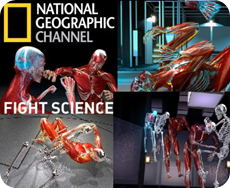
Initially planned as a stand-alone documentary, the show spawned three direct spin-offs titled, MMA, Special Ops: Super Soldiers, and Self Defence; as well as a dreadful ‘documentary’ based on the initial premise, dramatically entitled Kung Fu Killers: Top 10 Kung Fu Weapons.
Pros: The Fight Science series has been a mega hit with audiences. It has generated a huge awareness for martial arts and the capabilities of martial artists. It also attempts to tackle 'Martial Arts Myths' and the 'Which style is best?' question using scientific tests making it fairly unique – it was also the first show to use motion capture technology to explain techniques.
Cons: The biggest names on the show (Rickson Gracie, Dan Inosanto) were woefully underutilised. The scientists unfortunately have just about no knowledge regarding the martial arts (and also lack some common sense) in that they expect to be able to make a linear comparison between almost randomly selected practitioners! For example, comparing the punching power of an ex-pro heavyweight boxer with that of a lightweight kung fu forms champion is just silly! The follow-up episodes rectified this to an extent by testing the abilities of the individuals (and it's always amusing to see Bas Rutten flirting with some scientist in awe) though the tests/conclusions remained heavily flawed and unempirical. Actually…I could go on for pages on how poorly the tests were conducted – either way, it's an entertaining show with some interesting results…just watch it realising that the scientists don't really know what they're testing!
4. Human Weapon
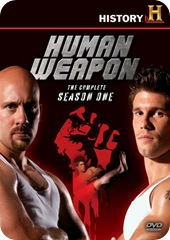 Aired on the History Channel, this was the revival of the martial arts travelogue. It lasted one season and involved the hosts travelling to a country to study its native martial art (in the form of a couple of basic techniques from different instructors) culminating in a 'fight' against a champion of the represented style.
Pros: Introduced many viewers to some lesser known martial arts; the show uses motion capture technology to help explain the major techniques taught to the hosts in each episode. Furthermore, Justin Chambers is a likeable host who, as an MMA representative, adds a sense of modernity to this otherwise old-school (anyone spot the clever BJJ reference?) format.
Cons: Bill Duff has absolutely no clue what he's talking about and often misquotes and misrepresents the episode's style – he also comes off as a bit of an ass. Furthermore, most of the final fights are intentionally toned down so as not to embarrass either the hosts or their opponents, which ends up misrepresenting the abilities of fighters on both parties (I mean, the Duffster only gets knocked out by the semi-contact TKD fighter? He even makes it sound like he's done well cause he's scrapped his knuckles in a Kyokushin match – even though that’s just a sign that his hands are poorly conditioned!).
(Oh, and the show has a lot of conservative undertones that don't really affect its quality but do bug me a little…)
3. Fight Quest 
Though it was filmed before Human Weapon, Fight Quest began airing on the Discovery Channel after Human Weapon had started on the History Channel. Similar in format to the aforementioned show except that the hosts (Jimmy Smith, veteran MMA fighter; Doug Anderson, US army veteran and rookie MMA fighter) are split up for five days while they train under two separate masters.
Pros: Both hosts are more open-minded and their willingness to learn, as well as to admit to their own shortcomings, is refreshingly clear to see. Spending five days learning from a single teacher allows the viewer to have a better understanding of the respective art and its training.
(…Watch the Krav Maga episode to see some seriously damaged people – poor Doug!)
Cons: The show intentionally chooses to showcase extreme forms of training and tends to ignore showing more conventional training methods – this tends to make styles seem somewhat inaccessible; it also reinforces stereotypes of mysticism or that one style is more 'hardcore' than another.
2. Mind, Body & Kickass Moves
This 10 episode series was initially broadcast on BBC Three and followed up by the Kickass Miracles series as well as the one-off Kickass in a Crisis. The show follows host, martial artist Chris Crudelli, around the Far East as he explores different martial arts (primarily, Chinese arts) – the main showcases are interspersed with Crudelli demonstrating martial arts-based tricks/magic to the UK public.
Pros: As the show aims to only introduce different arts, it is able to follow a wide range of masters and showcase their different methods of training. Furthermore, while Crudelli is wide open to the notion of chi, he is does place some critical comments in regards to some of the 'chi masters' (more so in Kickass Miracles). Lastly – there is actually a lot of good accurate information presented in a fairly true-to-life form.
Cons: The opening of the show states Crudelli is a 'master of combat and esoteric energies' – this is a sign of things to come! The show spends a great deal of time reminding us that Crudelli is a martial arts master (debatable since the point of the show is him visiting martial arts masters…); furthermore, the interspersed sequences make Crudelli look more like an arrogant, attention-hungry street magician than a humble martial arts master (a quick Wikipedia search will let you know that Crudelli was once an aspiring theatre artist …and it shows!).
1. Deadly Arts
This National Geographic show follows Aikido-ka Josette Normandeau around the world as she experiences what were some lesser known martial arts at the time (A second version of the show was filmed and hosted by Bollywood action star Akshay Kumar - who was a martial arts teacher before becoming an actor – Classic). Each episode focuses on one martial art in its home country with the host visiting different masters and then undertaking some form of final 'challenge' (not necessarily a fight). 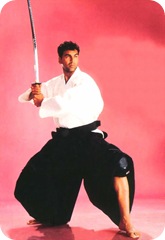
Pros: The show presents an honest take on every martial arts style examined (including child boxing in Thailand) – it does not look to flaunt the extreme nor mock what is not understood. It allows the viewer to objectively witness martial arts training and form their own opinions. Furthermore, the show pioneered later efforts such as Human Weapon and Fight Science. Lastly, not all the 'challenges' are fights (though some are) – this is a much truer representation of martial arts in my opinion.
Cons: Well, nothing's perfect. As well-meaning as she is, Josette Normandeau is unfortunately who lets the show down to some degree. Though I’m sure she is knowledgeable with 25 years of training behind her, she is also past her physical prime and thus unable to keep up  with a lot of the training, which in turn leads to a lot of whining followed by a predictable struggle to train for her upcoming challenge (which she inevitably passes – cue inspirational background music).
In truth, every resource has its strengths and weaknesses. Martial arts TV documentaries present some wonderful information but, be wary that most shows are from the perspective of an outsider looking in (potential victims of cultural relativism and ethnocentrism for you anthropology buffs) – don't use one show as the foundation of your knowledge or opinions. Read books instead (…yes, I said it!).
By the way…If anyone knows where I can watch the Deadly Arts with Akshay Kumar series, please do let me know!


